

Multi-digit multiplication can feel so daunting! There are so many sub-steps that sometimes it seems downright impossible that students will land on their feet with the right answer.
But it doesn’t have to be stressful. With these 8 hacks, teaching 2-digit by 2-digit (and 3-digit by 2-digit!) multiplication in 4th and 5th grade might actually be… FUN!
Table of Contents
Multi-Digit Multiplication Hack #1: Fact Fluency Has to Come First
If I had a dollar for every teacher who told me, “We’re going to practice fact fluency while we learn 2 x 2 digit multiplication” (or some version of that sentiment), I would have a very tall, very wet stack of dollars. Wet from all the tears.
Kids need phonics before they can access complex texts. Kids need fact fluency before they can access complex algorithms.
I’ve taught every grade level from 4th to 9th, and you know what I’ve never seen? A whole class that showed up already fluent in their facts.
So if your 4th or 5th graders don’t know their facts, that’s ok! To quote my dear friend Rafiki, we can’t run from this lack of knowledge. We have to face it head on!

The best way to tackle a lack of fact fluency QUICKLY? Skip-counting songs. Kids love them, they stick, and they turn fact practice into something your class actually looks forward to. You can get your kids from Point A (no fact fluency) to Point B (ready to tackle multi-digit multiplication) in just one week. 15 minutes per day. Day 1: 9s, Day 2: 8s, Day 3: 7s, Day 4: 6s, Day 5: 4s. Why reverse order? Start with the hardest so they have more time to absorb them!
Here’s my entire blog post on how to do this: Skip Counting Songs AKA My Secret Weapon for Fact Fluency
Multi-Digit Multiplication Hack #2: Always Estimate
The most common mistake kids make, especially with area models (see Hack #3), is dropping a power of 10 somewhere (aka dropping a zero). If we start with an estimate, students have a general sense of how big the product should be. It doesn’t need to be perfect. In fact, talking about overestimates and underestimates is a great way to build number sense.
How do you estimate? Simple! Round each factor to a friendly number and multiply. This usually means rounding to the greatest place, but not always.
Here are two different ways to round to friendly numbers to estimate 76 x 12:
- 76 x 12 → 80 x 10 = 800
- 76 x 12 → 80 x 12 = 960
Either one is great! The actual answer is 912, so one estimate is a little under and one is a little over, which is the perfect over/underestimate conversation starter. The whole point is that we pause when we end up with a product of 282, because we dropped a zero somewhere!
Here’s a Free Lesson on Estimating Products that shows kids how to do this:

Multi-Digit Multiplication Hack #3: Area Models Win Every Time
Yes, I’ve seen them all. Lattice, partial products, the standard algorithm.
The area model is the superior method and here’s why:
- Area models grows with your kids. They can carry kids all the way from 2 x 1 digit multiplication to 3 x 3 digit multiplication! (Lattice method, this is where you let us down. Sure, you get the right answer, but you’re basically a magic trick. Kids follow the diagonals without ever understanding why it works, and that’s pretty lame. When kids try the same method with 3 x 2, it’s a big fat mess!)
- Area models keep student work organized by design. Those boxes give kids the space they need to show their work for every single step. (Standard algorithm, with your “drop the 2, carry the 7, then add 4 more,” you are the stuff of math nightmares.)
- The empty boxes of the area models give students the steps. They know exactly what goes in each box, and that’s their path forward. (Partial products, you’re the only one I’m not truly mad at, but you still leave too much room for error with all that empty free space. Kids need boxes. BOXES.)
Does your curriculum require you to teach multiple methods? I think that’s great! Let kids see as many methods as possible. See what works and what doesn’t. Talk about the pros and cons. And then come back to area models, because I know you will.
Multi-Digit Multiplication Hack #4: Give as Much Scaffolding as Possible
Multi-digit multiplication is a complex skill, and kids are going to need a lot of gradual release.
Here’s what this looks like at the lesson level:
- 2 x 1 Digit Multiplication
- 3 x 1 and 4 x 1 Digit Multiplication
- 2 x 2 Digit Multiplication
- 3 x 2 Digit Multiplication
- 3 x 3 Digit Multiplication
But we actually need to scaffold within each lesson too.
(Note: I’m only showing area models because I believe they’re the superior method for reaching true mastery. But you could do the same thing with any method!)
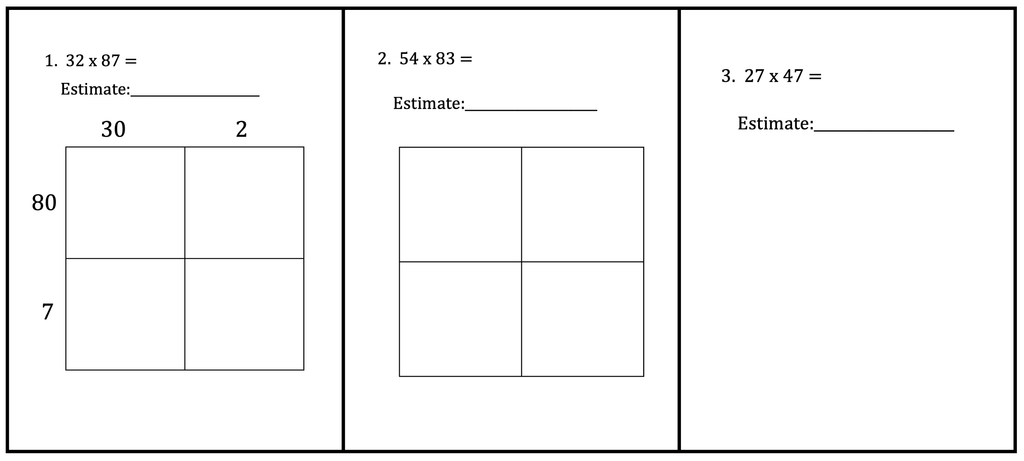
Notice how each problem gives kids a little less structure. In Problem 1, the boxes are drawn and the expanded factors are already labeled. In Problem 2, kids get the boxes but have to break apart the factors themselves. By Problem 3, they’re drawing the whole area model on their own.
You’d be amazed at how much this little boost helps reluctant learners get started.
Multi-Digit Multiplication Hack #5: And Then Scaffold Even More!
Some kids may need even more support than what I talked about in Hack #4.
For students with IEPs or 504 accommodations, or really any kid who needs extra support, it can be helpful to give them notes that are partially filled in.
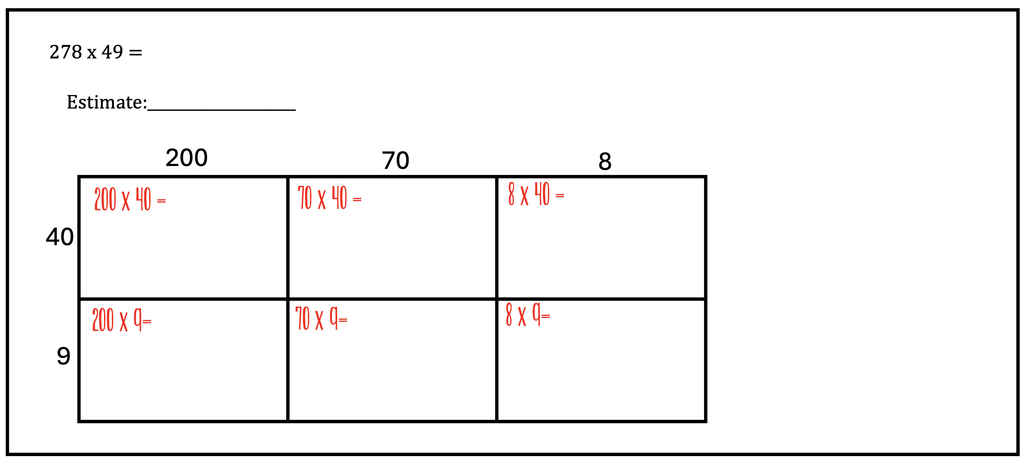
Here’s what that might look like for a 3 x 2 digit multiplication problem. Notice how each sub-problem is already written in its box, so kids can see exactly what to multiply. You might do this for the first page and then let kids take it from there. Or maybe they need it for the whole lesson, and that’s ok too!
Remember, Rome wasn’t built in a day. We’ll practice this for the rest of the year!
Multi-Digit Multiplication Hack #6: Use the Cover-Up Trick!
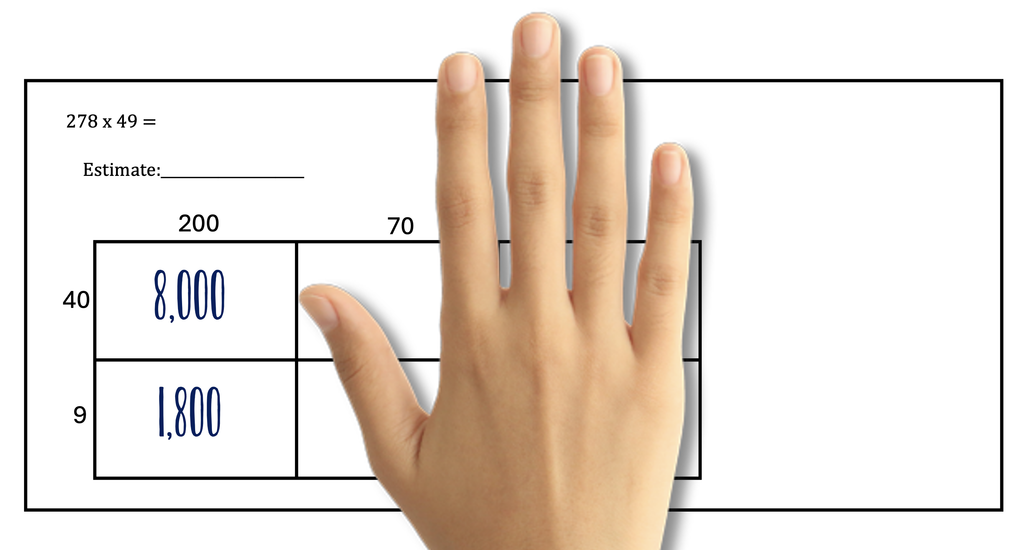
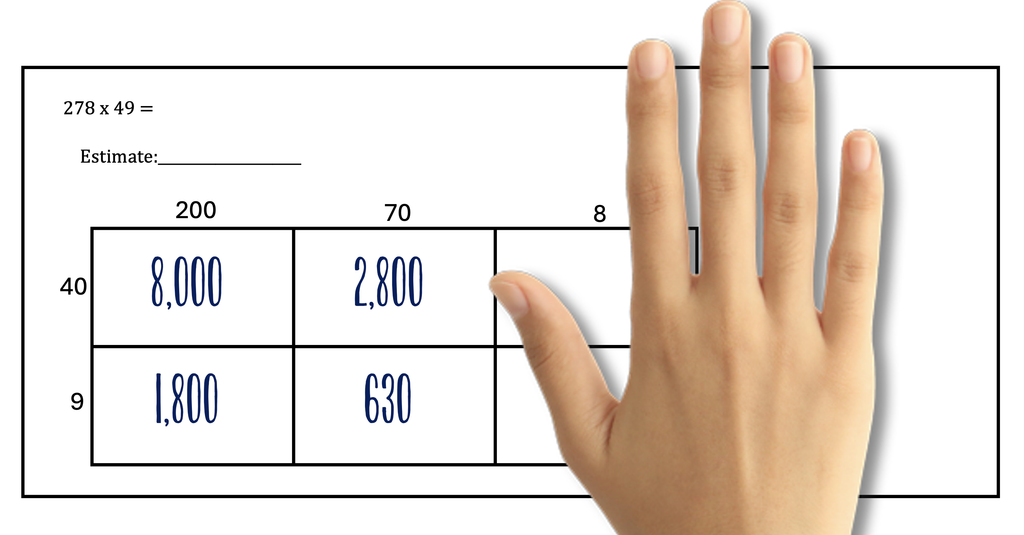
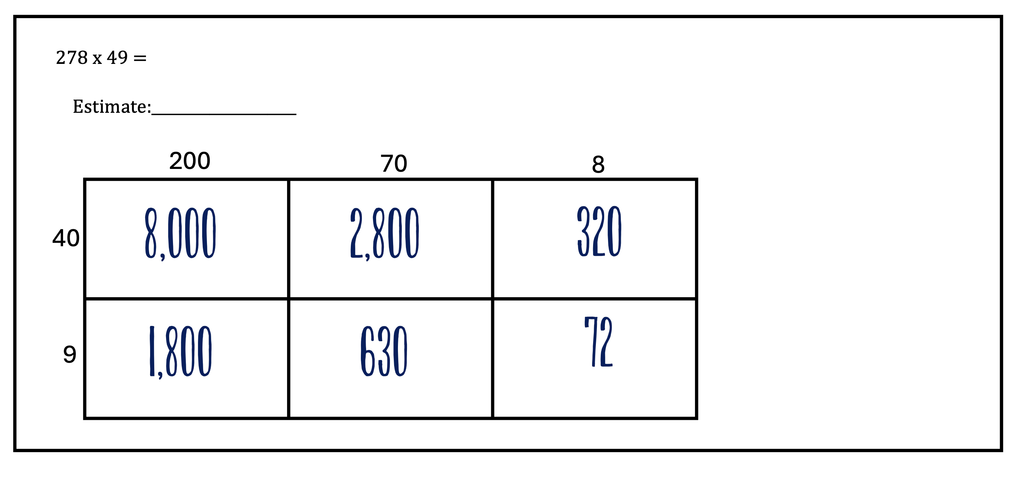
Sometimes just covering up part of the area model helps narrow the focus. Kids who struggle with spatial reasoning don’t always see clearly which two factors multiply to make each product. Covering up all but one column lets kids see exactly what they’re multiplying as they go.
Start with just the first column showing, then slide your hand (or even an index card!) to the right to reveal one new column at a time.
Multi-Digit Multiplication Hack #7: Never Add More than 3 Numbers at Once!
There is nothing more crushing than watching a student solve an entire problem with meticulous calculations, only to make a mistake on the VERY LAST STEP.
Here’s one of the harsh realities of multi-digit multiplication: you will see more addition mistakes than multiplication mistakes.
So don’t model adding all the partial products at once, and don’t let kids add this way either. Adding 6 (or even 4) numbers at once is a RECIPE FOR DISASTER!
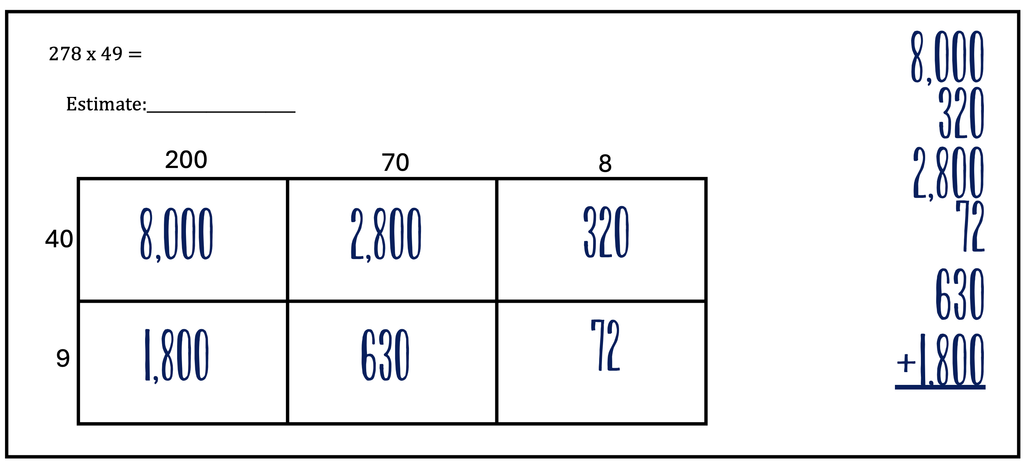
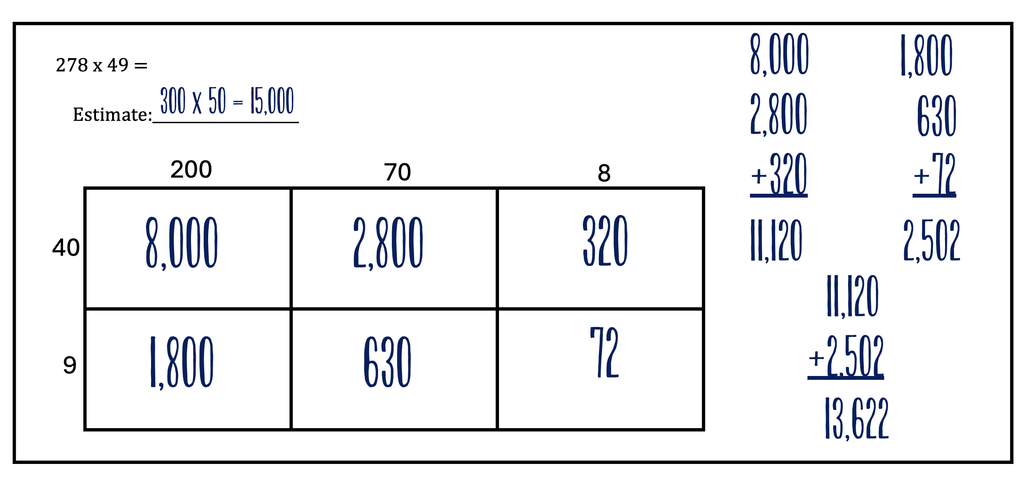
Do this instead! Break them into groups of 2 or 3. It really doesn’t matter how you group them, just GROUP THEM.
Multi-Digit Multiplication Hack #8: Scaffold by the Size of the Digits
Students are going to have a much higher success rate solving 41 x 23 than 89 x 79. Why? Because the partial products in the area model are smaller, which means they’re easier to calculate AND easier to add.
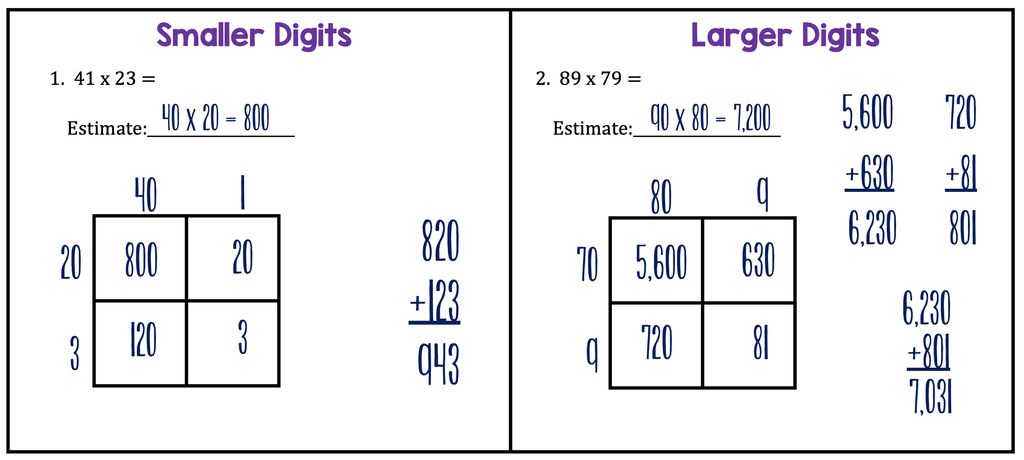
Both of these are 2 x 2 digit multiplication problems, but take a second to compare how much more of a mental lift the larger digits are. How many more opportunities are there for students to make an error?
I often encourage teachers to teach a full lesson with no digit larger than 5. This lets students master the steps of the area model before we level up the difficulty.
It’s also a great pre-teach lesson for intervention teachers to use with small group kiddos before they learn the skill in class!
Need More Support? I’ve Got You Covered!
Here are my 4th & 5th Grade Area Model Multiplication Units! Every lesson packet incorporates all the hacks I talked about here.
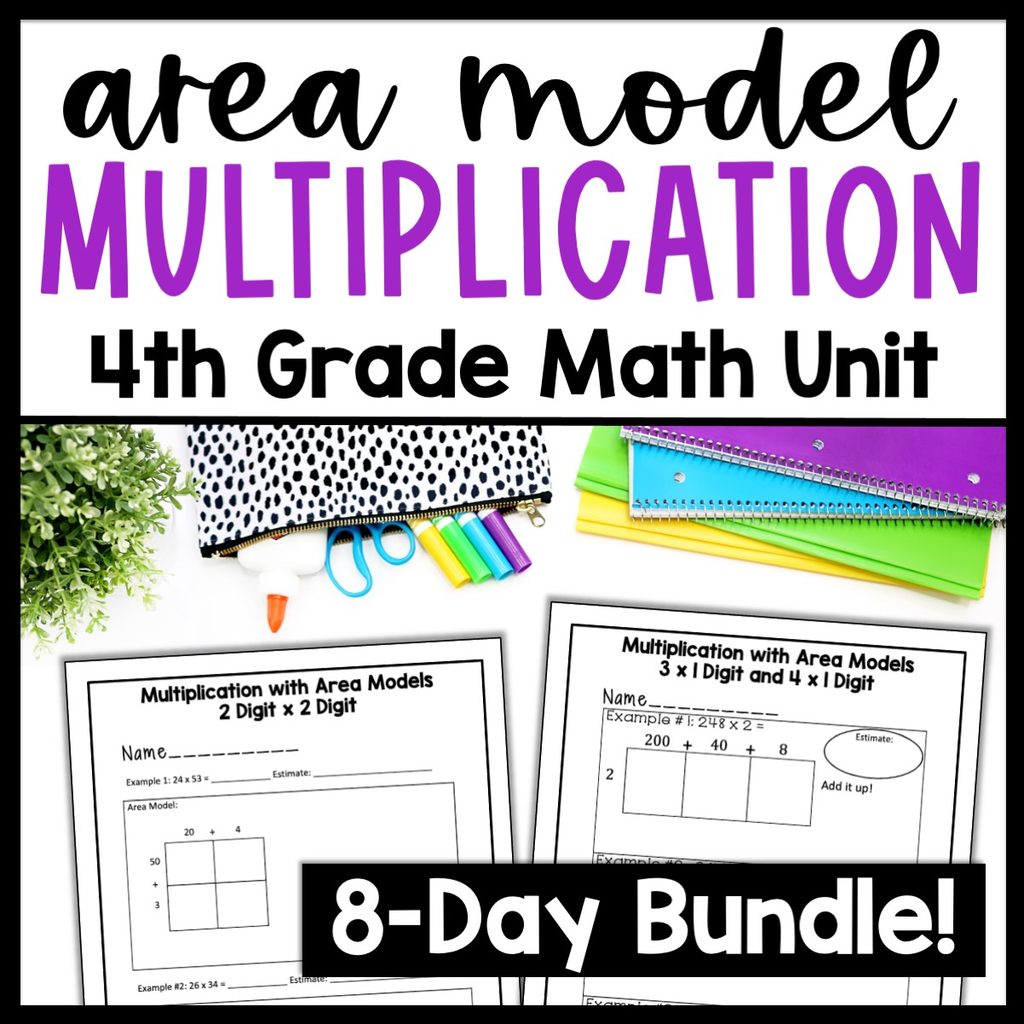
4th Grade Area Model Multiplication includes 8 complete lesson packets.
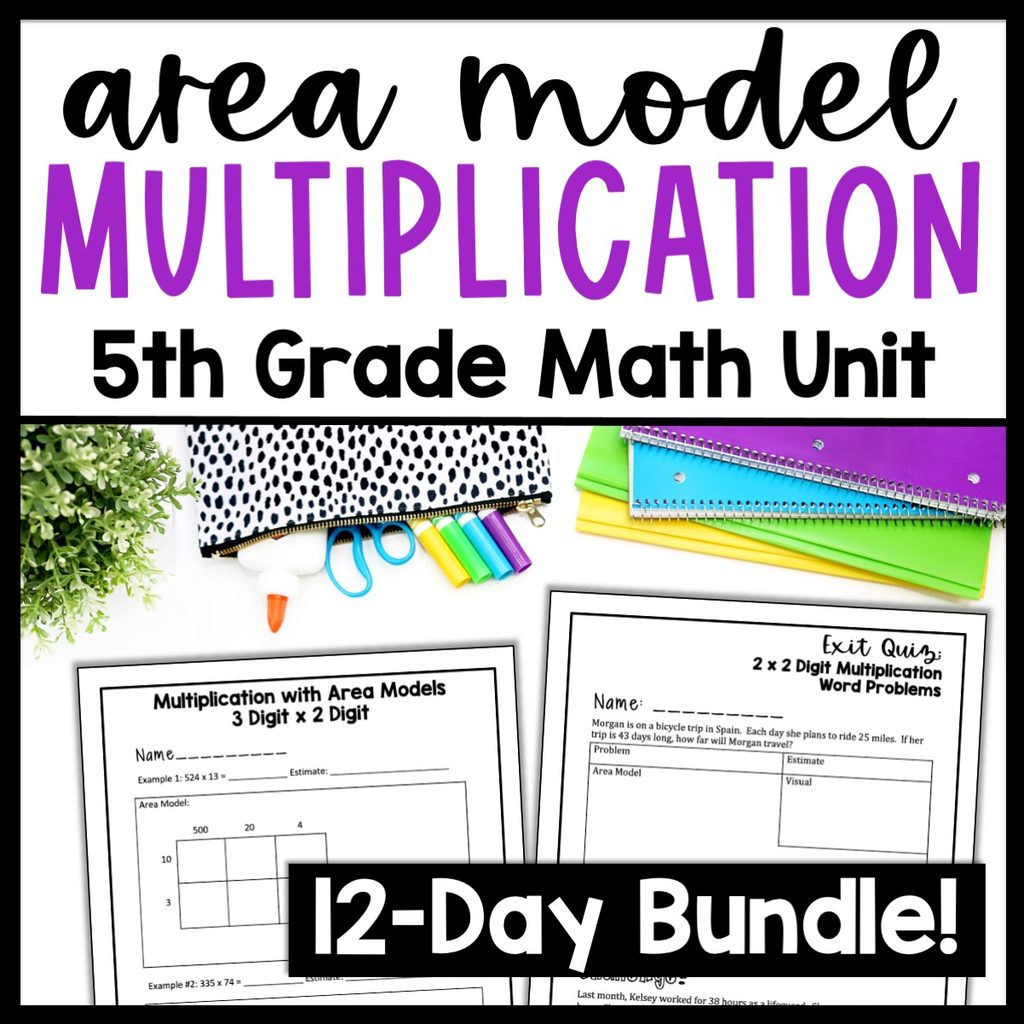
5th Grade Area Model Multiplication includes all the lessons from the 4th grade unit, plus 4 extra days on 3 x 2 digit and 3 x 3 digit multiplication. Why? Because 5th graders need the basics first!
Every lesson packet includes:
- Scripted Instructional Guides
- Teacher-Led Examples
- Partner Practice
- 3 Pages of Leveled Independent Practice
- A Challenge for Early Finishers
- An Exit Ticket
Grab the unit that’s right for you so you can skip the planning and get to the good part!
Final Thoughts on Teaching Multi-Digit Multiplication
Multi-digit multiplication is a BIG skill with a lot of moving parts, but your students can absolutely land on their feet. Start with fact fluency, estimate every time, lean on area models, and scaffold, scaffold, scaffold. Then keep the addition in small groups so all that hard work doesn’t fall apart on the very last step.
And remember, Rome wasn’t built in a day. Your kids won’t master this in a week, and that’s ok! Keep practicing, keep celebrating the small wins, and keep those boxes coming. Kids need boxes. BOXES.
Math love,
Sally 💛
Multi-Digit Multiplication FAQs
What grade do students learn multi-digit multiplication?
In Common Core states, students start in 4th grade. Standard 4.NBT.B.5 covers multiplying up to 4-digit by 1-digit numbers and 2-digit by 2-digit numbers using place value strategies like area models. In 5th grade, standard 5.NBT.B.5 expects students to fluently multiply multi-digit whole numbers using the standard algorithm.
What is the best way to teach 2-digit by 2-digit multiplication?
I’m a little biased, but my answer is the area model! It keeps work organized, shows students exactly which numbers to multiply, and works for any size problem. Start with an estimate, use numbers with smaller digits at first, and add lots of scaffolding.
What’s the difference between the area model and partial products?
They use the same math! Both break each factor into place values and multiply the parts. The area model organizes those products in boxes, while partial products lists them vertically. Area models give kids more structure, which is why I love them for introducing the skill.
Should my students know their multiplication facts before learning multi-digit multiplication?
Yes! Every box in an area model is just a basic fact with some zeros attached. If students are still working on their facts, spend a week building fluency first (skip-counting songs are my favorite way) before you start multi-digit multiplication.
Why do my students keep getting the wrong answer even though they understand the steps?
Usually it’s one of two things: a dropped zero or an addition mistake. Having students estimate first helps them catch dropped zeros, and adding partial products in groups of 2 or 3 cuts down on addition errors.
When should students move from the area model to the standard algorithm?
Never!!! Hahaha, jk jk. But kind of not. Students do need to be familiar with the standard algorithm (it’s part of the 5th grade standards), but honestly? As their preferred method, I’m fine if they’re still using area models when they’re 80. It’s the method I use whenever I need to solve a BIG UGLY multiplication problem without a calculator.