The issue with paper in a math classroom is… that there’s so much of it.
Math is a practice subject. Kids get good at it by doing forty problems, not by reading about doing forty problems. So the paper isn’t a side effect of my teaching. It is my teaching. The only problem is that nobody ever tells you what to do with all the paper afterward.
So we have a binder system or an interactive notebook system. And then we slowly go insane.
Here’s how I manage paper in my math classroom instead.
Table of Contents
First of all, how much paper are we talking about, Sally?
Y’all. So, so much paper. Here’s one normal day, per student in my classroom:
- Warm Up — 1 sheet
- Fluency — 1 sheet
- Lesson Packet — 3 sheets, front and back
- Exit Ticket — 1 sheet
- Homework — 1 sheet, front and back
That’s 7 sheets a day. I teach 100 students. So that’s 700 sheets a day, 3,500 a week, and somewhere around 126,000 sheets a year.
I’m so sorry, rainforests. If I had a textbook that actually worked for my students, I promise I’d use less. But I’m still waiting on that curriculum deal with the big companies. Any day now, right?
If I have to choose between conserving paper and my students actually LEARNING, I pick kids. And I’m pretty sure you would too.
Now. If I spent my time getting 100 students to organize 5 different assignments and 7 pages of paper every single day, I would lose my EVER LOVING MIND. So I don’t. They turn it in, I recycle 90% of it, and I don’t feel bad about about it.
Ok so what’s the catch?
There isn’t one. I’m going to address the two most common pain points with paper. Student accountability and access to the content they need.
- Pain Point #1 Student Accountability: Students need to feel that every problem they solve in your room matters and is working towards an end goal.
- Pain Point #2 Student Access: Students need access to key information, example problems, and vocabulary every day.
Let’s address each of these concerns separately.
Pain Point #1: Student Accountability
Students need to feel that every problem they solve in your room matters and is working toward an end goal.
Accountability doesn’t mean I grade and return everything. And it definitely doesn’t mean students have to keep everything.
The learning is in their brains. Whether it’s in an organized binder or in the trash can, you can’t take that practice away from them.
Here’s the part that took me a while to understand: I’m not throwing away the record. I’m throwing away the container. The fluency tracker holds the progress. The spreadsheet holds the homework data. The gradebook holds the exit ticket. Every single one of those outlives the paper it came from.
Henceforth, the recycle bin shall be known as File 13, because it just sounds classier.
Let’s go through my math block part by part:
- Warm Up: We go over most missed questions.
- Homework: We check 5 random problems. Students give themselves a grade. We pass in Warm Up and HW together. HW gets entered into a special spreadsheet separate from my grade book (by students) and Warm Ups go in File 13.
- Fluency: How many problems can you do in one minute? We check it. We track our progress. We pass it in. File 13.
- Daily Lesson Packet: Six pages of intense practice: direct instruction, partner practice, independent practice, and a challenge for early finishers. We go over the highest-impact problems, the ones that tee us up for the exit ticket. Then we pass in the packet and… you guessed it. FILE 13.
- But wait! All that beautiful learning, in the recycle bin?
- Yes. Because the learning already happened. It happened during the partner practice and the arguing about problem 4 and the third attempt at the area model. The packet is a receipt for work that’s already done. I don’t need it in a binder to prove it.
- Exit Ticket: This is it! The one piece of paper a day that I collect and grade and return to them. The exit ticket is a holy, sacred thing that holds everyone accountable, closes the loop, and stops misconceptions before they start. But once students have looked it over, guess what? They File 13 it too! Ok, ok. Sometimes they **strut** across the classroom and hang it up (click here for more details).
Want to read more about each of these systems? Here you go!
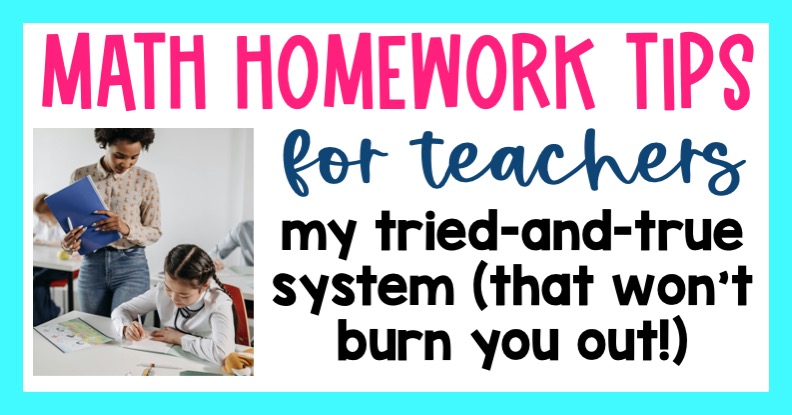

Notice what all of those systems have in common: not one of them needs the paper to survive the class period. (Well I guess, technically the exit ticket lives to see the next day, but that’s it!)
The warm up did its job in the first eight minutes. The fluency sheet did its job in sixty seconds. The packet did its job over forty minutes of practice. By the time that paper hits File 13, it has already given me everything it had.
That’s accountability. Not storage. Kids know their fluency numbers are climbing because they can see the tracker. They know homework counts because they graded it themselves. They know the exit ticket matters because it comes back with a grade and notes about anything they missed.
Not one of those things lives in a binder.
But here’s the fair question, and it’s the one I get every single time I talk about this:
If they don’t keep anything, what does a kid look at when they get stuck? What does the kid who was absent Tuesday do on Wednesday? What happens the night before the test?
Great question. That’s pain point #2.
Pain Point #2: Student Access
But their notes?! How do they check back on their notes from previous lessons?
Two words: cheat sheets.
Every unit gets one. A single sheet of brightly colored cardstock, printed front and back, laminated.
So what’s on it?
- All the knowledge for that unit, in one place
- Key words and student-friendly vocabulary definitions
- Worked example problems
- Teaching hacks, Jingles, and Pro Tips I’ve collected over two decades of teaching math
- BOLOs (Be On the Lookout Fors): the common traps designed to trick you
The first three are what every reference sheet has. The last two are why my students actually use theirs constantly.
Where it lives. The current unit’s sheet sits on every desk. Every previous unit’s sheet lives inside the desk. So when a decimal question turns up in the warm up in March, nobody goes digging in a messy binder. They know that’s the yellow one.
Warm up and homework time look like a big fat rainbow in my room.
And a second copy goes home. Every student gets another set of cheat sheets to keep at home for homework. Parents love this, especially the ones who are skeptical of all this “new math.” Now they can see exactly how we’re doing it, and they can actually help.
“Okay, but you just invented a binder.”
No, and the difference is the whole point. A binder is an archive of everything a student produced: 200 pages, unsorted, most of it never opened again. This is a reference library of everything a student might need: no more than 10 sheets over the entire year, curated by me and color-coded.
If you’ve ever seen a middle schooler’s binder, you know exactly why this is a game-changer.
The kid who was absent Tuesday has the exact same reference on Wednesday that everyone else does. The kid studying the night before the test isn’t flipping through a binder hoping the good stuff is in there somewhere. The good stuff is the sheet.
Also, I have a lot more thoughts about absent students that you can read right here!
Can students use their Cheat Sheets on the Exit Ticket?
Usually no. When we start our exit ticket, that means we’ve entered assessment-mode. No talking, and cheat sheets go in the desk.
The white cheat sheet
This is the easiest accommodation I have ever run, and it costs nothing. For students who need extra support or have an IEP, I print the cheat sheet on plain white paper and staple it to the back of their quiz.
The white paper is the whole trick. A brightly colored cheat sheet announces itself from across the room. A black-and-white one stapled behind the quiz looks like part of the quiz and removes the stigma from the student who is using it.
Here’s what they can use in assessment-mode
These are separate from cheat sheets but still worth noting.
- Number spelling sheets. For the love of all that’s holy, please let them use this on the exit quiz so we can all learn to spell thousandths correctly.
- Place value charts. Taped to every desk. When we hit powers of 10, we need all the help we can get.
- Measurement conversion charts. Students are allowed to use these on state tests, so I want them practicing with them on every formal assessment. This version is different from their measurement cheat sheet — it’s the conversion chart only, none of the other inside info.
Ok sign me up! Where can I get these magical cheat sheets?
I thought you’d never ask.
4th and 5th grade are fully built out — one for every single unit.
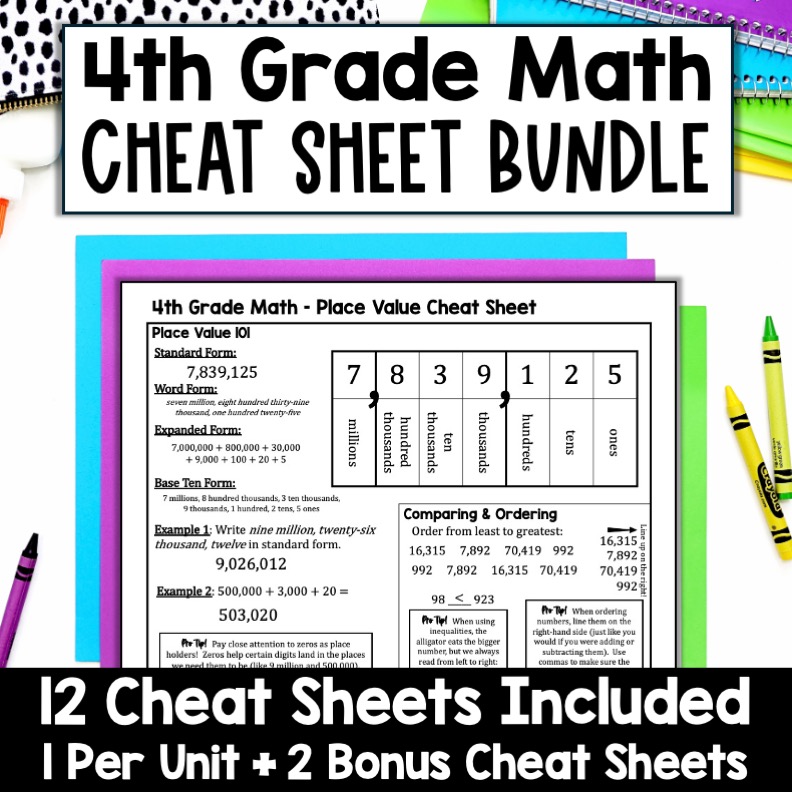
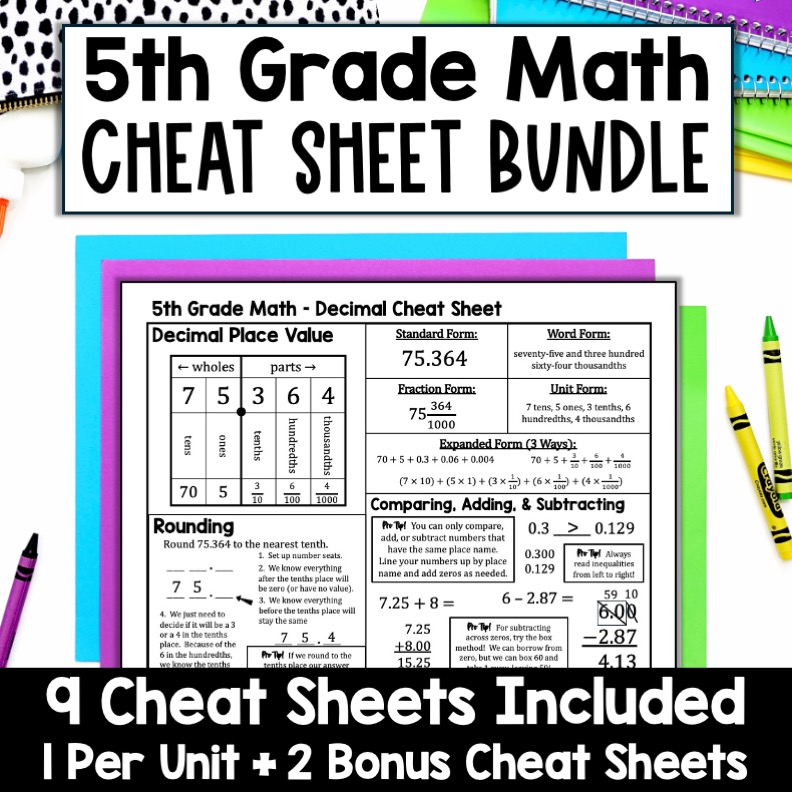
3rd and 6th will be up by Spring 2027.
Teaching 3rd or 6th? Get on the list and I’ll tell you the second the new cheat sheets ready!
These might be the best resources I have ever made, and not because they’re pretty (which they most certainly ARE). They’re the piece that makes everything else in this post work. Every Pro Tip, every BOLO, every “watch out, this one gets everybody” I’ve collected in two decades of teaching math is on them. That part doesn’t come from a curriculum company. It comes from watching 3,000 kids make the same mistake.
If I could magically teleport these cheat sheets back to 2004, my first few years of teaching would have had a lot fewer tears in them. Mine and theirs.
Want to make your own instead? Please do. One piece of advice: vocabulary and examples are the easy part, and they’re also the part that doesn’t get used. The traps and the tricks are why a kid actually reaches into their desk in March.
But I don’t need cheat sheets! I do interactive notebooks!
Okay. I haven’t been in YOUR classroom. But I have been in hundreds of math classrooms.
And I understand the appeal. Everything in one place, kids building it with their own hands, and a real argument that making a thing helps you remember it. They also look so freaking cute when they are done well!
But what I see in almost every instance is a lot of cutting. And pasting. And making foldables that are never quite as clear as you thought they would be. And don’t forget about filling in blanks, SO slowly, because kids write SO slowly. What I don’t see much of is math.
So here’s the honest question: could those minutes be better spent on good old-fashioned pencil-to-paper math?
And if I had to guess, the notebooks are already driving you insane. Friend, it’s okay to let them go.
But I don’t need cheat sheets! I do anchor charts!
Sally, a cheat sheet is basically a mini anchor chart. How could you possibly have a problem with anchor charts?
I don’t. I love them.
But here’s the problem: somebody in your room can’t see it. I don’t care how gorgeous it is. Your room is big, you have a lot of kids, and on any given day quite a few of them need glasses they don’t have.
And here’s the bigger problem: your anchor chart has an expiration date. That beautiful chart from unit 1 is long gone by unit 6, because you needed the wall space. It never went home for homework. And it is no help whatsoever to the kid who hits a decimal question in March and needs what you taught back in October.
Every single cheat sheet is still in that desk. Decimal question? That’s the yellow one.
A cheat sheet is also up close and personal. Kids can hold it, point at it, track along with a finger. And nobody has to shout I CAN’T READ THAT from the back row.
So if you love anchor charts, keep making them. Just put that need-to-know information on every desk, too.
But I don’t need cheat sheets! I do binders! And I believe organization is a life skill!
Yes. I agree. Organization is a life skill, and I want my kids to be organized as much as the next person.
You know what else are life skills? Personal hygiene. Public speaking. Parallel parking. Writing a thank-you note.
We can only teach so much. And here’s my situation: my kids come to me multiple grade levels behind in math. Every minute in my room is already spoken for. So when the choice is a minute spent on decimals or a minute spent getting thirty kids to put a worksheet behind the right tab, that is not a hard call.
Learning to organize a binder is not what gets them caught up to grade level. So I’d rather spend those minutes on what does. Pencil to paper math practice.
Ok so what does your paper turn in system actually look like?
How I manage paper in my math classroom (logistically):
Two bins per class period. Turn in, and pass back. That’s the whole system.
The pass back bin holds exactly one thing: yesterday’s exit ticket. (Or one from a few days back, if somebody was absent.) I hand these out during the warm up, which gives me a quick chance to conference with any kid who made a specific mistake.
The turn in bin is one gigantic stack of paper. But it’s already in order, and that’s not an accident. Everything gets passed in in the order we did it, so the stack sorts itself:
- Lesson packets on top, stapled. Instant File 13. I do it when they’re not looking, not because it’s a secret, but because a ten-year-old watching their packet hit the bin is a conversation I don’t need at 9:15.
- Fluency next. Ditto.
- Warm up and homework on the bottom, shuffled together because they got passed in as a pair. Student helpers separate them, enter the homework grades, and then… you guessed it. File 13.
The exit tickets never go in a bin at all. Students put them face down in the center of the desk and start homework when they finish. I collect them and clip them in a class set, because they are SACRED.
And then I grade them almost immediately. While my next class is taking their Exit Ticket. That’s the entire reason one graded paper a day doesn’t bury me. It gets graded in the exact window the next group spends doing the same thing.
Final Thoughts on Managing Paper in a Math Classroom
Here’s what I actually want you to take from this, whether you ever buy a single resource from me or not.
The paper is not the learning. It never was. That stack on the corner of your desk isn’t proof your students learned anything. The proof is the kid who can do the thing in March that wrecked her in September. It’s the hand that goes up before you’ve finished asking the question. It’s the day a kid doesn’t reach into the desk for the yellow sheet, because they don’t need it anymore.
You’re allowed to let the paper go.
File 13 is waiting.
Math love,
Sally 💛
FAQs About Managing Paper in a Math Classroom
What should teachers do with student work after it’s graded?
Most of it can be recycled because the goal (practice) has been reached. My exceptions are homework, which my student helper’s enter in a spreadsheet (read more about this system here). And then the Exit Ticket, which I grade every day and return the next day (read more about this system here).
Do students need binders in math class?
No. A binder is an archive of everything a student produced, and most of it is never opened again. A curated set of reference sheets gives students the information they actually need without spending instructional minutes on filing and organizing.
What’s a good alternative to interactive notebooks?
A one-page-per-unit cheat sheet on colored cardstock. Students get the same reference benefit without spending 15 minutes a session cutting, folding, and gluing — time that can go to actual math practice instead.
How do absent students catch up if you don’t keep their work?
They use the same cheat sheet everyone else has. Because the reference material is separate from the practice work, a student who missed Tuesday has exactly the same access to key information on Wednesday as a student who was there. Read all about my system for absent students here.
What goes on a math cheat sheet?
Key vocabulary in student-friendly language, worked example problems, all the essential knowledge for the unit, plus teaching tips and common traps to watch for. The last two are what make students reach for the October cheat sheet in March.
Can students use a cheat sheet on a quiz or test?
Usually not — assessment mode means cheat sheets go in the desk. Exceptions include students with IEP accommodations (print theirs in black and white and staple it behind the quiz to remove the stigma) and reference tools students are permitted on state tests, like conversion charts.
How do parents stay in the loop if papers don’t come home?
Send a second copy of every cheat sheet home. Parents who feel lost with “new math” can see exactly how it’s being taught and actually help with homework — often more useful than a backpack full of completed worksheets.