
If I had a dollar for every teacher I’ve seen try to cram GCF and LCM into one day… I’d have a LOT of dollars.
Here’s the thing: this concept isn’t hard.
Which is exactly why people rush through it.
But when we speed through teaching factors and multiples, we miss one of the BEST opportunities in upper elementary math to build deep number sense.
And that number sense matters far beyond a unit test.
A strong understanding of factors and multiples helps students with:
- Simplifying fractions
- Finding least common denominators
- Measurement conversions
- Area and Volume
- Fact fluency
- Scale factors
- Ratios and proportions
- Factoring polynomials
This is foundational math.
So if you’re a teacher who believes in teaching knowledge for LIFE and not just knowledge for the end-of-year test…
Then prove it.
If you’re teaching factors and multiples, give it FIVE FULL DAYS. Trust me on this.
Here’s what to do with each one.
Table of Contents
Day 1: Teach Multiples with Skip Counting Songs
Teaching multiples becomes SO much easier when students know their skip counting songs.
Seriously.
If your students can confidently sing:
“3, 6, 9, 12, 15…”
then finding multiples suddenly feels automatic instead of overwhelming.
And when students can quickly generate multiples, skills like:
- Finding the LCM
- Finding common denominators
- Recognizing patterns
- Multiplication fluency
all become significantly easier.
Needless to say… I’m a huge fan of skip counting songs. Don’t know what I’m talking about? You can read my blog post about it here:
Skip Counting Songs: My Secret Weapon for Math Fact Fluency
Yes, I know. You don’t like singing. Me either, friend.
In fact, I am possibly the most tone deaf person on the planet. If I can sing in front of my students AND on YouTube, you can too.
Your students do not care if you sound like a pop star.
They care that learning feels fun, memorable, and engaging.
Here’s some receipts! Trust me, no one is too cool for singing in math class!
And songs WORK. Kids remember rhythm and repetition far longer than they remember worksheets.
Honestly, if you don’t have a way to sing your way through multiples, LCM, and later common denominators…
I don’t really know how to help you.
Day 2: Don’t Sleep on the Divisibility Rules
Before you teach students to find the GCF, teach them to use the divisibility rules for 2, 5, 10, and 3.
(The rules for 4, 6, 7, 8, 9, 12, and 15 are also useful — and extremely entertaining to explore.)
Why start here? Because divisibility rules are the tool that makes everything else in this unit faster, easier, and more fun. You’ll see them show up on every single day that follows.
My love for these rules runs so deep that I wrote an entire blog post about it:
Why You Should Teach Divisibility Rules (and How to Make It Fun)
Days 3 – 4: Find Factors with T-Charts
One of the biggest mistakes students make when finding factors is skipping around randomly and accidentally missing factor pairs.
This is why I LOVE factor T-charts.
Go in order. Every single time.
Start with:
- 1 and the number itself
- Then test 2
- Then 3
- Then 4
- And so on
This is where the divisibility rules become indispensable.
Finding the Factors of 48
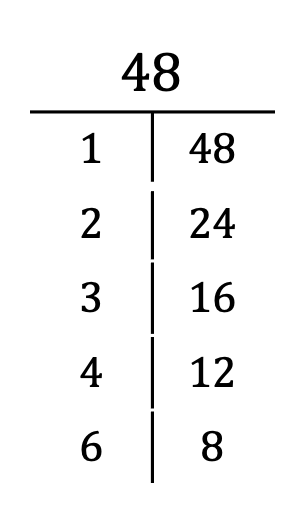
First factor pair? 1 and 48.
Next: Is 48 even?
Yes! There’s an 8 in the ones place, so it’s divisible by 2.
48 ÷ 2 = 24, so the next factor pair is 2 × 24.
Now test 3. Is 48 divisible by 3?
Yes! Because 4 + 8 = 12, and 12 is divisible by 3.
48 ÷ 3 = 16, so: 3 × 16.
What about 4? Yes! 4 × 12 = 48.
What about 5? Nope. Numbers divisible by 5 must end in 0 or 5.
What about 6? Yes! 6 × 8 = 48.
What about 7? No. 7 × 7 = 49, so we’ve already passed it.
At this point, students can see that the factor pairs are beginning to “meet in the middle.”
That visual is HUGE.
It helps students understand:
- Why factors come in pairs
- Why lists don’t continue forever
- How square numbers behave differently
- How to know when they’re finished
This is number sense gold.
And see how the divisibility rules are indispensable for the facts that go beyond our times tables!?
Yes, factors and GCF need two days. One day to master the factor t-chart and one day to focus on finding the GCF.
Day 5: Prime & Composite Numbers… But Make It Hip Hop
Prime numbers are usually only explicitly taught in 4th grade, but students need this understanding for YEARS afterward.
There are so many cool conversations you can have around prime numbers.
For example:
2 is the only even prime number.
Why? Because every other even number can be divided by 2 as well as 1 and itself — meaning it has more than two factors.
No prime number greater than 5 ends in 5.
Why? Because every number ending in 5 is divisible by 5.
0 and 1 are NOT prime numbers.
This one surprises students every year.
- 0 has infinitely many factors
- 1 only has ONE factor
Prime numbers must have exactly TWO factors: 1 and themselves.
And once again… SEE THE DIVISIBILITY RULES?!
I will never stop talking about how much I love them.
The Prime Number Song
If you know me, you know I love making students sing nerdy math songs.
Extra bonus points if they’re based on early 2000s hip hop.
This might honestly be my favorite one ever.
Prime Numbers in a Private Club Dancing (To the tune of “Tipsy” by J-Kwon)
2, here comes the 3 to the 5 to the 7
11, 13, 17 prime heaven 19, 23, 29, 31 37, 41, 43, 47
Err body in a private club dancing. (whisper) Err body in a private club dancing
Prime numbers in a private club dancing (whisper) Prime numbers in a private club dancing
Just 1 and me it’s just 1 and me
Prime numbers now, prime prime numbers now
Just 1 and me it’s just 1 and me
Get it?? The prime numbers are dancing in a private club because it’s just one and me (aka just one and the prime number). Man, math jokes KILL ME!
Here’s some more receipts that kids love this stuff. Have you ever seen a happier group of nerds?
Want a 5-Day Unit that’s ready to use tomorrow?
Are you ready for the most impactful week of the year? Then it’s time to teach factors and multiples with purpose. When I tell you this week is the gift that keeps on giving. For the rest of the year and for every teacher your students will have in the future.
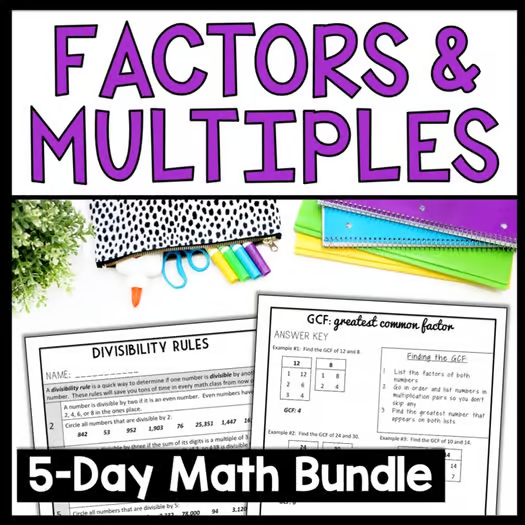
Here’s a print and go unit that covers everything mentioned above!
Each of the 5 lesson packets includes:
- Teacher lead examples
- Partner Practice
- 3 pages of leveled Independent Practice
- Challenge for early finishers
- Exit Quiz
Final Thoughts
Notice what happens when you slow down like this.
By taking the time to teach factors and multiples this way, your students aren’t just memorizing the procedure. They’re using divisibility rules they’ve discovered, factor lists they can visualize, and multiples they can rattle off in their sleep.
That’s the difference between teaching for the test and teaching for LIFE.
Five days. That’s all it takes.
Trust me on this.
Math love,
Sally 💛
FAQ: Teaching Factors and Multiples
What is the difference between a factor and a multiple?
Factors are the numbers you multiply together to get a number — the factors of 12 are 1, 2, 3, 4, 6, and 12. Multiples are what you get when you multiply a number by 1, 2, 3, and so on — the multiples of 12 are 12, 24, 36, 48… Here’s how I say it to students: factors fit inside a number, multiples grow out of it.
What order should you teach factors and multiples?
Multiples first because they are a breeze with skip counting. Then the divisibility rules, two days on factors (finding factors and then GCF), and then close it off with primes and composites (because SO FUN!).
What grade levels explicitily teach factors and multiples?
In most standards, factor pairs and prime vs. composite numbers are taught in 4th grade, and GCF and LCM are formally taught in 6th grade. But students lean on these skills constantly in between — especially for fraction work in 4th and 5th grade — which is exactly why they deserve more than one day.
What is the fastest way to find all the factors of a number?
Use a factor T-chart and test numbers in order: start with 1 and the number itself, then 2, then 3, then 4, and so on, using divisibility rules to test each one quickly. When the pairs “meet in the middle,” you know the list is complete — no missed factors, no guessing.
Why is 1 not a prime number?
A prime number must have exactly two factors: 1 and itself. The number 1 has only ONE factor (itself), so it doesn’t qualify. It’s not composite either — it’s in a category all its own.
What’s the difference between GCF and LCM?
The GCF (greatest common factor) is the largest number that divides evenly into two or more numbers — you use it to simplify fractions. The LCM (least common multiple) is the smallest number that two or more numbers both divide into — you use it to find common denominators. If students can list factors and multiples confidently, both become easy.



2 Responses
Love the five-day structure, especially putting divisibility rules on Day 2 before the T-charts. The rules really are the engine that makes factor listing fast instead of guessy, and sequencing it this way means the T-chart days feel like application rather than brand-new learning. One thing I’d add: after students see the factor pairs “meet in the middle” with 48, ask them to predict where the meeting point will be before they start the next number. It builds exactly the intuition for why square numbers end up with an odd factor count. I run factorcalculator.org, a free factor/GCF/LCM calculator site, and the most common question we hear is how students know when to stop testing – your visual answer to that is number sense gold, exactly as you say. Also, “just 1 and me” from the prime song is going to live in my head rent-free now!
I love having them estimate where they think the numbers will meet in the middle! So many good opportunities to talk about perfect squares! Thanks for taking the time to read!