
Table of Contents
Why Divisibility Rules Matter
Can we talk about divisibility rules for a second? Because so many teachers skip them entirely, and they are SUCH an important foundation for number sense.
Truthfully, I didn’t even know most of these rules until I became a teacher. Now? I use them all the time. In everyday life, at the grocery store, and constantly while teaching math.
Divisibility rules help students:
- Simplify fractions more efficiently
- Recognize patterns in numbers
- Strengthen multiplication and division fluency
- Develop stronger mental math skills
- Build confidence with large numbers
And honestly… kids think they’re pretty cool. That alone is worth the class time.
Start with the “Easy” Rules
You probably know the rules for 2, 5, and 10 without even thinking about them. Your students? Not so much.
Divisible by 2: If a number is even, it can be divided by 2.
Divisible by 5: If a number ends in 0 or 5, it is divisible by 5.
Divisible by 10: If a number ends in 0, it is divisible by 10.
These seem almost too simple to bother teaching, but hear me out. They are HUGE for building Base 10 understanding. Students start noticing patterns in place value and learn to work with big numbers so much more efficiently.
For example, once a student recognizes that a large even number can be split in half, that number instantly becomes smaller and way less intimidating.
Teach the Rule for 3 Early
Please teach the divisibility rule for THREE.
For the love.
The divisibility rule for 3 is an absolute game changer, especially once students start simplifying fractions.
Divisible by 3: If the digits of a number add up to a multiple of 3, the number itself is divisible by 3.
Examples:
- 24: 2 + 4 = 6, so it’s divisible by 3
- 321: 3 + 2 + 1 = 6, so it’s divisible by 3
- 1,002: 1 + 0 + 0 + 2 = 3, so it’s divisible by 3
Kids LOVE this one because it feels like a magic trick.
Honestly? Adults love it too. Try it at your next staff meeting and watch what happens.
More Divisibility Rules Worth Exploring
Once students have the basics down, there are so many more patterns to dig into:
- Divisibility rule for 4
- Divisibility rule for 6
- Divisibility rule for 7
- Divisibility rule for 8
- Divisibility rule for 9
- Divisibility rule for 12
- Divisibility rule for 15
Here’s the thing: your students do NOT need to memorize every single rule right away. The real value is in exploring patterns, making conjectures, and testing ideas. That’s the good stuff.
Build Number Sense Through Challenges
This is where divisibility rules really shine. They create AMAZING opportunities for critical thinking.
Try giving students prompts like:
- Think of a 4-digit number divisible by 2 but not by 3.
- Think of a 2-digit number divisible by both 2 and 3, but not by 5.
- Find a number divisible by 4 and 6 but not by 8.
- Create the largest number possible that is divisible by 9.
These kinds of tasks push students to think deeply about numbers instead of just memorizing procedures. And isn’t that what we actually want?
Let Students Discover the Rules
Want to take it up a notch? Don’t tell students the rule at all.
Give them a list of multiples and let THEM figure out the pattern.
For example:
12, 24, 36, 48, 60…
Then ask:
- What do you notice?
- What patterns do you see?
- How could you tell if a large number belongs in this list?
Suddenly divisibility rules aren’t a worksheet full of memorization. They’re a problem-solving activity.
And that’s where the real learning happens.
A Fun Way to Strengthen Critical Thinking
Here’s my favorite part: divisibility rules are about so much more than division.
They help students:
- Notice mathematical structure
- Look for patterns
- Make predictions
- Justify their reasoning
- Develop flexibility with numbers
Plus, students genuinely love feeling like they know “secret math tricks.”
That excitement matters. It’s the kind of thing that turns “I’m bad at math” kids into pattern hunters.
Can’t get enough of these rules?
I’m right there with you, ya big nerd!
I have a complete lesson packet that teaches the rules from start to finish and has an early finisher challenge with some of the harder rules (12, 15, etc.). It even includes an exit quiz!
If you’re looking for more of a game or activity, try this Divisibility Rule Number Sort! Also available as a digital activity!
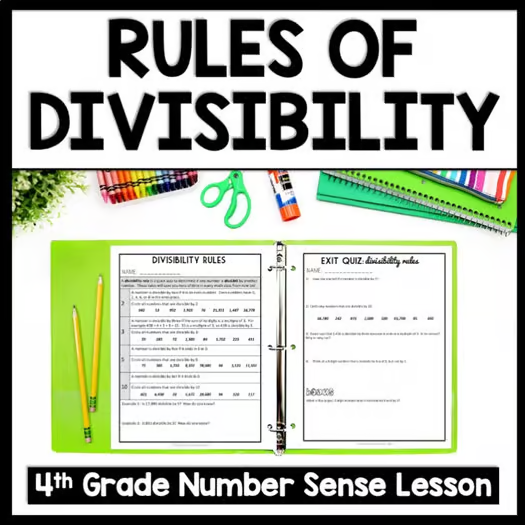
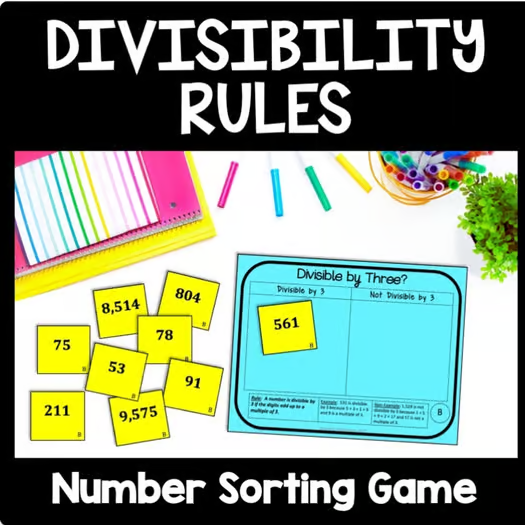
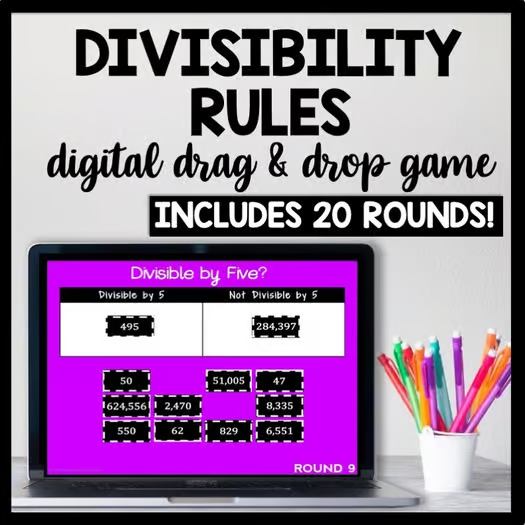
Grab them today to make divisibility rules meaningful, engaging, and actually FUN for your students!
Final Thoughts
If divisibility rules have been sitting at the bottom of your priority list, this is your sign to bump them up.
They don’t take long to teach, they pay off all year long, and they give students something we can’t put a price on: the feeling that numbers make SENSE.
So please, don’t skip them. Teach the twos. Teach the fives. And for the love, teach the THREES.
Your future fraction-simplifying students will thank you.
Math love,
Sally 💛
What grade should I teach divisibility rules?
Divisibility rules are typically introduced in 4th or 5th grade, right around the time students are working on factors, multiples, and simplifying fractions. That said, younger students can absolutely handle the rules for 2, 5, and 10, and older students benefit from a refresher more than you’d think.
Do students need to memorize all of the divisibility rules?
Nope! Start with 2, 3, 5, 9, and 10. Those get used the most, especially when simplifying fractions. The rest are great for exploration and pattern work, but memorizing every rule is not the goal. Understanding WHY the rules work matters way more.
Why does the divisibility rule for 3 work?
Short answer: place value. Every power of 10 is one more than a multiple of 9 (think 10 = 9 + 1, 100 = 99 + 1). So when you add up the digits, the leftover “multiples of 9” part is already divisible by 3, and the digit sum tells you about the rest. You don’t need to prove this to your students, but exploring it makes a fantastic extension activity.
How do divisibility rules help with fractions?
They make simplifying SO much faster. Instead of guessing and checking, students can look at 48/72, notice both numbers are divisible by 3 (and by 2, and by 6), and simplify with confidence. It turns a frustrating process into a quick mental check.
How long should I spend teaching divisibility rules?
Not long at all! A few focused lessons plus quick warm-ups and challenges sprinkled throughout the year works beautifully. They make perfect bell ringers, early finisher tasks, and “we have five extra minutes” activities.