
It happens every year.
You master the four basic operations like pros. Your students are adding, subtracting, multiplying, and dividing like nobody’s business.
But the second you introduce two-step word problems? The wheels fully fall off the wagon.
So what’s the deal? Why can’t my students solve two-step word problems?
If your students can handle the four basics but suddenly seem to forget everything they know when a word problem has two steps, there’s probably more going on than you think.
Here are three mistakes you might be making when teaching two-step and multi-step word problems (and what to do instead).
Table of Contents
2-Step Word Problem Mistake #1: You didn’t spend enough time teaching “Choosing the Operation” as a separate skill.
Identifying the operation in a word problem is a skill in itself.
Knowing how to multiply and knowing when to multiply are two entirely different things, and they deserve practice in two very different ways.
So often, I see a long-term plan that looks something like this:
- Addition Computation → Addition Word Problems
- Subtraction Computation → Subtraction Word Problems
- Multiplication Computation → Multiplication Word Problems
- Division Computation → Division Word Problems
- AND THEN FINALLY: 2-Step Word Problems
Okay, so what’s the problem?
When I teach a lesson called “2 × 2 Multiplication Word Problems,” my kids aren’t really doing anything different from what they did the day before in my “2 × 2 Multiplication Problems” lesson.
In fact, they probably aren’t even reading the problem.
Why?
Because I told them the operation on the very first page.
Words, words, words, words, NUMBER, words, words, words, words, ANOTHER NUMBER.
Y’all. Kids are smart. And they LOVE shortcuts.
If you tell them upfront that every problem is multiplication, they’re going to skip the reading, grab those two numbers, and multiply them.
Are they getting good practice with the multiplication algorithm?
Totally.
Are they learning how to recognize a multiplication problem?
Not in the slightest.
So let’s rework that long-term plan a little bit and make it actually work toward multi-step word problems.
Instead of this:
- Addition Computation → Addition Word Problems
- Subtraction Computation → Subtraction Word Problems
- Multiplication Computation → Multiplication Word Problems
- Division Computation → Division Word Problems
- 2-Step Word Problems
Try this:
- Addition Computation → Addition Word Problems
- Subtraction Computation → Word Problems: Addition vs. Subtraction
- Multiplication Computation → Word Problems: Addition vs. Multiplication
- 2-Step Word Problems: Addition, Subtraction & Multiplication
- Division Computation → Word Problems: Multiplication vs. Division
- One-Step Word Problems: All Operations
- Two-Step Word Problems: All Operations
What’s the difference?
Computation is a skill that can be taught in isolation.
But when I’m teaching word problems, I want my students to inherently be choosing between at least two possible operations.
Otherwise, what’s the point?
If I tell students, “Today we’re solving multiplication word problems,” I’ve already done one of the most important pieces of thinking for them.
They’re practicing multiplication.
They’re not practicing figuring out when multiplication makes sense.
And that distinction becomes REALLY important when we get to two-step word problems.
2-Step Word Problem Mistake #2: You Leaned Too Heavily on Keywords
“In all” and “total” mean addition.
“More than” and “less than” mean subtraction.
“Each,” “every,” and “per” mean multiplication.
These blanket keyword statements are doing some serious damage to our kids.
Why?
Because “in all” and “total” can also mean multiplication.
“More than” and “less than” can also mean addition.
And “each,” “every,” and “per” don’t automatically mean multiplication. They describe repeated groups, which can lead to either multiplication or division.
Let’s look at a simple example.
There are 4 bags with 6 apples in each bag. How many apples are there in all?
There’s your keyword: in all.
If students have been trained to see “in all” and immediately think addition, they might add 4 + 6.
But that’s not what the problem is describing.
It’s describing 4 equal groups of 6.
That’s multiplication.
The problem isn’t the keyword.
The problem is the meaning.
Instead of teaching students to hunt for keywords, teach them to ask:
What is actually happening in this problem?

Is this a combining groups problem?
Or is this a repeated groups problem?
If it’s a repeated-groups problem, then ask:
Do I know the total, or am I trying to find the total?
If I know the number of groups and the amount in each group and I’m trying to find the total → multiplication.
If I know the total and the amount in each group and I’m trying to find the number of groups → division.
That’s a MUCH more useful strategy than memorizing a list of words.
And here’s why this matters so much for two-step word problems.
A student who has been trained to look for keywords is going to try to find a word that tells them what operation to use.
A student who understands the meaning of the operations can actually analyze what is happening in the problem.
And that’s exactly the thinking we need them to do when a problem has two steps instead of one.
Because a multi-step word problem isn’t asking:
“Can you find the keyword?”
It’s asking:
“Can you figure out what is happening, decide what needs to happen first, and then use that information to figure out what happens next?”
That’s a completely different skill.
2-Step Word Problem Mistake #3: You Aren’t Getting the Full Benefits of Drawing Models
The first thing we ask is- “What’s happening in this problem?”
The second thing we do is model it.
Because modeling the problem will help students use the definitions of the operations to choose the correct 2 steps.
Let’s look at an example:
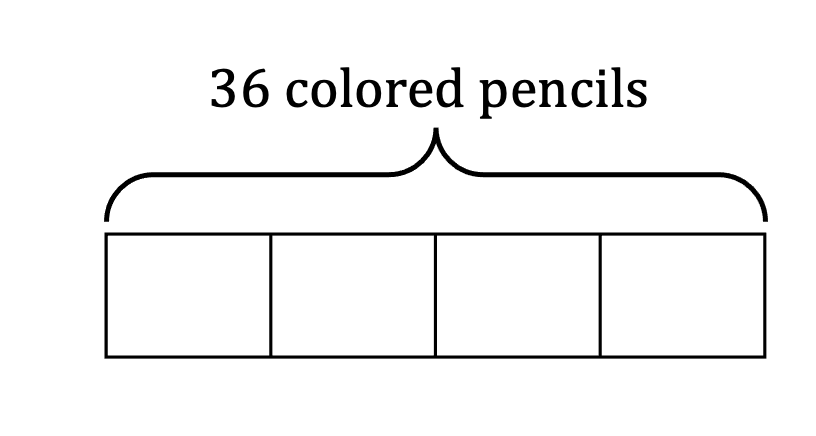
Anthony bought 36 colored pencils. The colored pencils were split equally among 4 boxes. Anthony opened the first box and gave 3 pencils to his friend Sara. How many pencils are left in the box Anthony opened?
- Teacher– What’s the first thing that happens in this problem?
- Kids– The colored pencils are being split into 4 equal groups.
- Teacher– Let’s model it!
- Teacher– Ok, what operation does this look like?
- Kids– Division, because we are splitting a group into equal groups of the same amount.
- Teacher– What’s my equation?
- Kids– 36 ÷ 4
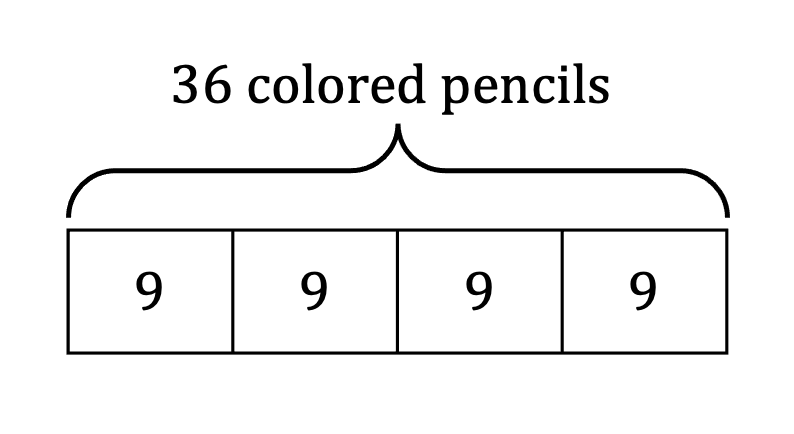
- Teacher– Great! How many colored pencils are in each box?
- Kids– 9 colored pencils
- Teacher– Let’s update our model.
- Teacher– Ok, what’s the next thing happening in this problem?
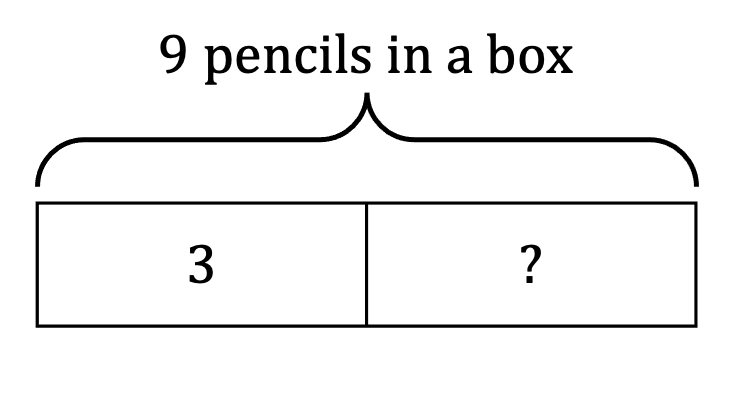
- Kids– Anthony opens one box and takes out 3.
- Teacher– Ok, let’s model that one box.
- Teacher– What operation does this look like?
- Kids– Subtraction, because we are taking some out of an existing group.
- Teacher– What’s my equation?
- Kids– 9 – 3 = 6 colored pencils left
- Teacher– So what’s the answer to my problem?
- Kids– There are 6 colored pencils left in the box Anthony opened.
Notice how I didn’t mention keywords once.
Instead, we read the problem, figured out what was happening, and drew a model of exactly what was happening.
The model made the math visible.
And once students could see the math, choosing the operation wasn’t a guessing game anymore.
What’s that?
You want another example?
Friends, I could do this all day.
Literally.
Is that sad?
Let’s look at a 4th grade example this time.
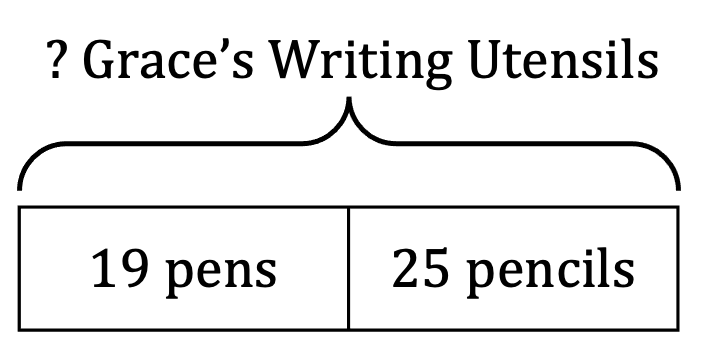
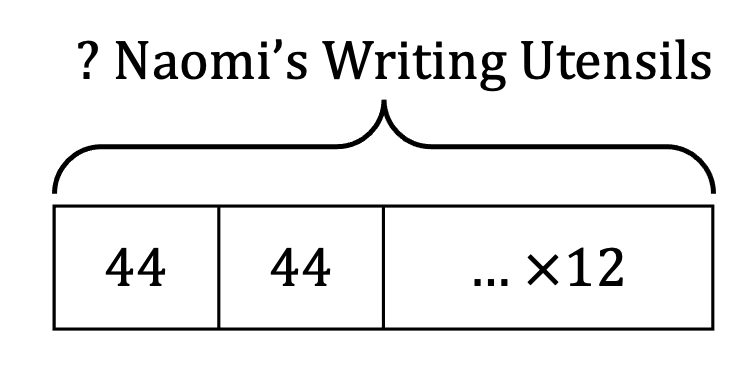
Grace has 19 pens and 25 pencils. Naomi has 12 times as many writing utensils as Grace. How many writing utensils does Naomi have?
- Teacher– Ok, what’s the first thing happening in this story?
- Kids– Grace has 19 pens and 25 pencils.
- Teacher– Ok, let’s model that.
- Teacher– What operation does this look like?
- Kids– Addition, because we are combining groups.
- Teacher– What’s my equation?
- Kids– 19 + 25 =
- Teacher– How many writing utensils does Grace have?
- Kids– 44 writing utensils in all
- Teacher– Ok, what happens next in this story?
- Kids– Naomi has 12 times as many writing utensils as Grace
- Teacher– Let’s model that!
- Teacher- What operation does this look like?
- Kids– Multiplication, because it’s repeated groups of the same amount. Naomi has 12 repeated groups of 44 writing utensils.
- Teacher– What’s my equation?
- Kids– 44 x 12
- Teacher– What’s the answer to this word problem
- Kids– Naomi has 528 writing utensils
And again, we never had to hunt for a keyword.
We simply asked:
- What’s happening?
- What does that look like?
- What operation matches that model?
- What’s my equation?
- What’s happening next?
That’s the routine.
And THAT is the thinking I want my students doing when they solve multi-step word problems.
Not hunting for words.
Not grabbing the first two numbers they see.
Not guessing which operation the teacher wants.
Thinking. Modeling. Connecting the situation to the math.
That’s how we move from “I know my multiplication facts” to “I know when multiplication makes sense.”
Ok, Sally, but my curriculum doesn’t follow this lesson sequence!
And I don’t want to create all these word problems from scratch.
Oh, I thought you’d never ask!
You don’t have to.
I’ve already done the work for you.
These are 10 full lesson packets covering 1-step and 2-step word problems, including practice with identifying the correct operation.
Each of these 10 word problem packets includes everything you need for a complete lesson:
- Teacher-led examples
- Partner work
- 3 pages of scaffolded independent practice
- Challenge page for early finishers
- Exit ticket
- Detailed instructional guide
And here’s the important part:
I don’t recommend teaching them all in a row.
Instead, use them after you introduce each operation and build in those extra opportunities for students to practice choosing the operation.
Remember the sequence we talked about above:
The Ideal Lesson Sequence:
- Addition Computation → Addition Word Problems
- Subtraction Computation → Word Problems: Addition vs. Subtraction
- Multiplication Computation → Word Problems: Addition vs. Multiplication
- 2-Step Word Problems: Addition, Subtraction & Multiplication
- Division Computation → Word Problems: Multiplication vs. Division
- One-Step Word Problems: All Operations
- Two-Step Word Problems: All Operations
That makes this bundle PERFECT to supplement whatever curriculum you are using.
Just build in a few extra days to practice choosing between various operations.
You don’t need to change your curriculum.
You don’t need to create a whole new unit.
You just need to give your students more opportunities to practice the part of word problems that often gets overlooked:
Choosing the operation.
Final thoughts on 2-Step Word Problems
If your students are struggling with two-step word problems, don’t assume they need more two-step word problems.
They might need something different.
They need more practice figuring out what operation to use.
They need to understand that the words in a problem don’t automatically tell them which operation to choose.
And they need to learn how to model what’s happening so they can see the math before they try to solve it.
Remember the three big mistakes we talked about:
1. You’re not explicitly teaching students to choose the operation.
Knowing how to add, subtract, multiply, and divide is different from knowing when to use each operation.
2. You’re relying too heavily on keywords.
“Total” doesn’t always mean addition. “More than” doesn’t always mean subtraction. And “each” doesn’t always mean multiplication.
3. You’re not using models to their full potential.
When students can model what’s happening in a word problem, they have a much better chance of connecting the situation to the correct operation.
And here’s the big takeaway:
Two-step word problems aren’t really about two steps.
They’re about making two mathematical decisions.
What is happening first?
What operation matches that situation?
Then what happens next?
What operation matches that situation?
When we teach students to think that way, we’re doing more than helping them survive the next word-problem worksheet.
We’re teaching them how to actually make sense of math.
And honestly? That’s the goal.
Math love,
Sally 💛
2-Step Word Problems FAQs
What is a two-step word problem?
A two-step word problem is a problem that requires students to use two operations or two mathematical steps to find the answer. The answer to the first step is typically needed to solve the second step.
For example, a student might first need to add two quantities together and then multiply the total by a given number.
Why do students struggle with two-step word problems?
Students often struggle with multi-step word problems because they require more than computation. Students have to understand the situation, identify what is happening, choose the correct operation, solve the first step, and then determine what to do next.
Students who have been taught to rely on keywords may have an especially difficult time because two-step problems require them to understand the meaning of the situation rather than simply look for a word that tells them which operation to use.
How do you teach students to solve two-step word problems?
Start by teaching students to identify what is happening in the problem before asking them to choose an operation.
Have students model the situation, identify the operation that matches the model, write an equation, and solve. Then repeat the process for the second part of the problem.
A simple routine is:
What’s happening? → Model it → Choose the operation → Write the equation → Solve → What’s happening next?
Should students use keywords to solve word problems?
Keywords can be helpful vocabulary, but students should not rely on them as a shortcut for choosing an operation.
Words such as total, more, less, each, every, and per can appear in problems involving different operations. Instead, teach students to focus on the meaning and structure of the problem.
What should students do first when solving a two-step word problem?
Students should first determine what is happening in the story. Before choosing an operation, ask students to identify the first action or relationship described in the problem and model it if possible.
This helps students determine which operation actually matches the situation.
How can I help students who are good at computation but struggle with word problems?
Give students opportunities to practice the problem-solving decision, not just the computation.
Instead of telling students that every problem on a page is multiplication, for example, give them a mixture of addition, subtraction, multiplication, and division problems and ask them to determine which operation makes sense.
The goal is to help students understand the difference between knowing how to perform an operation and knowing when to use it.
What’s the difference between a 1-step and a 2-step word problem?
A 1-step word problem can be solved with one mathematical operation or step. A two-step word problem requires students to complete one step and then use that information to complete a second step.
The important difference isn’t simply the number of operations. Multi-step word problems require students to connect two pieces of mathematical reasoning.
How do you teach multi-step word problems?
A strong way to teach multi-step word problems is to break the problem into the individual situations that are happening within the story.
Have students identify what happens first, model that situation, choose the operation that matches it, and solve. Then have them identify what happens next and repeat the process.
This keeps students focused on understanding the mathematics instead of trying to guess which operations the problem requires.
What are some strategies for solving multi-step word problems?
Useful strategies include:
- Read the entire problem before choosing an operation.
- Ask, “What’s happening?”
- Identify what happens first.
- Draw a model of the situation.
- Choose an operation based on the meaning of the problem.
- Write an equation.
- Solve the first step.
- Use the answer from the first step to determine what happens next.
- Check that the final answer makes sense in the context of the problem.
Most importantly, teach students to make sense of the situation before they start calculating.