Ever feel like your classroom is stuck in an endless loop of:
“What’d you get for number 9?”
“57!”
…over and over and over.
Is this thing on? Bueller? 😅

If you are bored with your classroom, imagine how the kids are feeling!
The good news is that breaking out of the answer-getting rut doesn’t require a whole curriculum overhaul. Sometimes we just need to mix up the math questioning strategies. Here are five to try this week.
Table of Contents
5 Questions to Ask Instead of “What’s the Answer?”
1️⃣ Give the answer, then ask: How did I get it?
Flipping the script takes the pressure off answer-getting and puts the focus where it belongs: on the thinking. When students already know the destination, all their brain power goes toward figuring out the route.
This math questioning strategy works especially well for a tricky question where your worried kids might not know.
For example, the perimeter problem below is challenging.
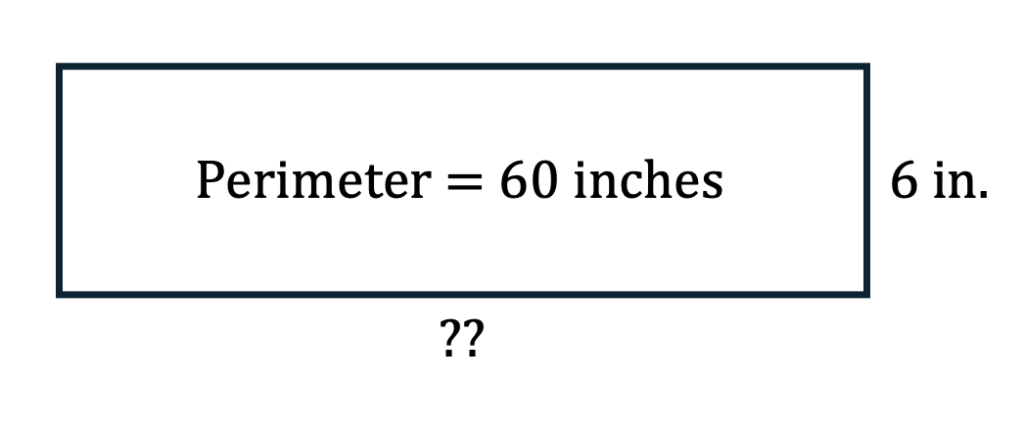
I could say: What’s the length of the rectangle? Which might lead to a “Bueller Moment”
Or, I could say. The length of this rectangle is 24 inches. How did I get that?
Suddenly the flood gates open and kids have a lot to say!
2️⃣ Give the answer and show work, then ask: Can you find another way to the get the same answer?
This math questioning strategy is my favorite for building flexibility. Students start to see that math isn’t one rigid path. There are lots of ways up the mountain, and finding a second route is where the real thinking happens.
Let’s stick with the above perimeter example. Explain to the class how you found 24 inches as the lenght. I knew that two of the lengths together had to make 48, because that was what was left after I took off the 12 inches for the two widths.
Who thought of it differently?
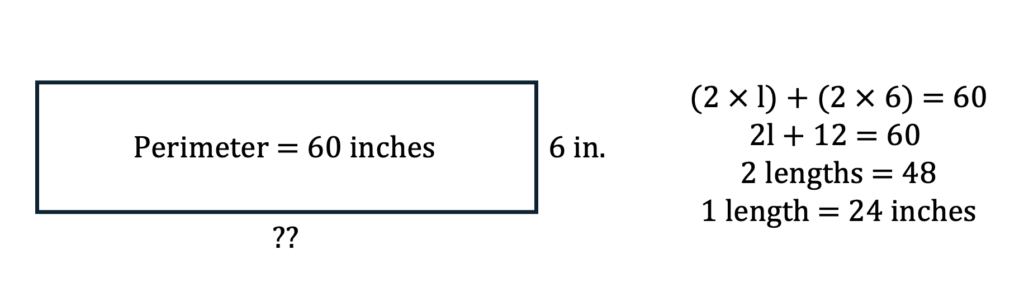
Here you might have a student say- “Well I know that the L + W has to make 30 inches, because 2 lengths + 2 widths makes 60 inches.”
Or another student might show you how they estimated that the length looked about 4 times longer than the width and then guessed and checked to see if they were right.
You can see how powerful this tool is!
3️⃣ Make a mistake on purpose, then ask: What did I do wrong?
Kids LOVE catching the teacher in a mistake. Use that to your advantage! Error analysis is one of the fastest ways to deepen understanding, because students have to know how something works in order to spot where it broke.
So for the perimeter example, I might tell students I’m going to make a mistake on purpose.
Or I might just proceed to see who’s paying attention!
It could sound like this- If the perimeter is 60 inches and the width is 6 inches, I just need to subtract 6 inches and I’m left with the length right? So the length is 54 inches?
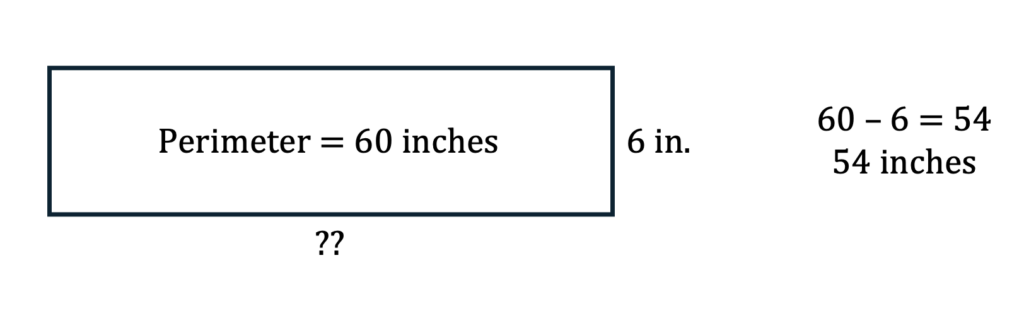
When students raise their hands to tell you what you did wrong (which they will do vigorously I might add), they will be forced to tell you the definition of a perimeter. “We need to add up all the sides. 4 sides. 2 lengths and 2 widths. You only added 1 length and 1 one width, which is basically half the rectangle.”
Also, this creates a culture where making mistakes is ok! All of us are still learning new things every day, including the teacher!
4️⃣ Ask: What’s the first step you would take to solve this problem?
Not the whole solution. Just the first step. This math questioning strategy lowers the stakes for your hesitant students and gets more hands in the air. It also shows you exactly where thinking goes off track, before anyone has filled a page with work.
It doesn’t have to be the correct answer, just any step that moves the needle in the right direction.
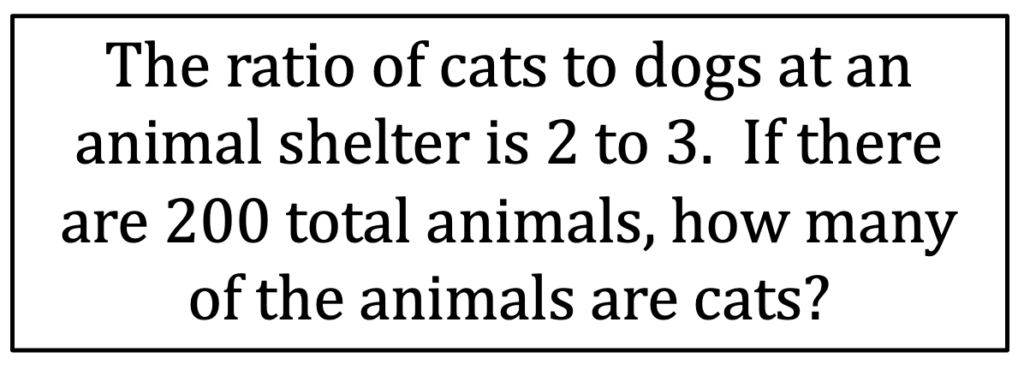
For this 6th grade ratio problem the list of possible first steps is literally endless:
- Set up a ratio table, tape diagram, number line, etc.
- Set up a proportion
- Change our part-part ratio to a part-whole ratio
- Repeated subtraction
- Guess and check
The list goes on and on! And meanwhile you are affirming to kids that there isn’t just one recipe for success. All brains are different and beautiful.
5️⃣ Ask:Why does this method work? Could you explain it in your own words?
This math questioning strategy is especially powerful when you can use student work (reason #8,782 why I heart document cameras) to showcase a method you’ve never thought of before. How empowering for that kid as everyone tries to see things the way they see them.
Did I mention math is empathy?
Suppose you’re working on this 6th grade ratio problem and your circulating your room and you see THIS on a student paper. I mean, isn’t this the stuff math dreams are made of?
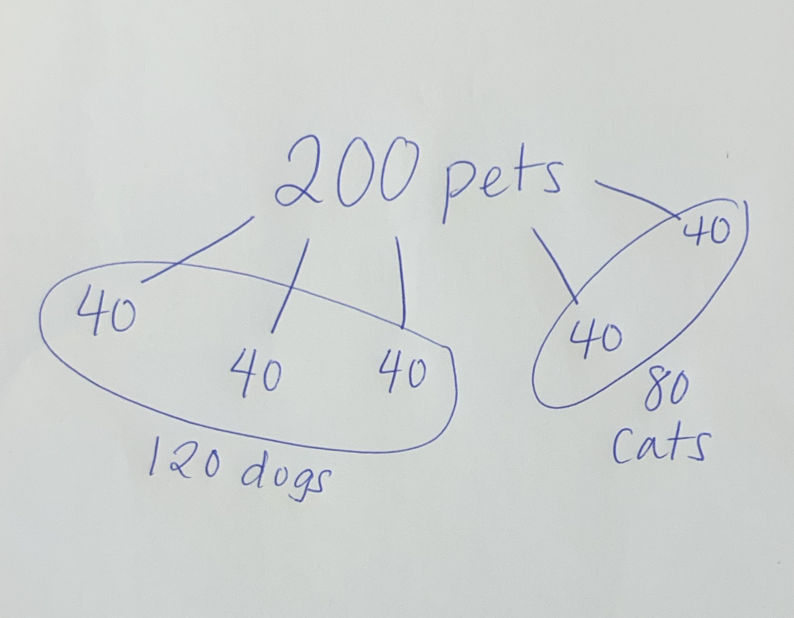
Asking students to explain what this student did to find 80 cats it such a gateway to understanding the meaning of ratios. This student saw the 2:3 ratio and new that meant 5 parts total. They broke the 200 in 5 equal parts and then distributed them accordingly to dogs and cats.
Trust me: lightbulbs will be going off left and right!
Bottom line- if a student can explain the why, they own it. If they can’t, you’ve just found your next teaching point. Either way, you win.
Ready to Take it Farther?
If you’re trying to build a classroom where these types of discussions take place, you need to give your students problems that lend themselves to multiple methods and critical thinking.
So often, I see teachers wait until “Test Prep Season” to start practicing performance tasks, when in reality it should be a daily or weekly part of your lesson!
I have a bundle of performance tasks for each grade level with flexible thinking and problem solving in mind!
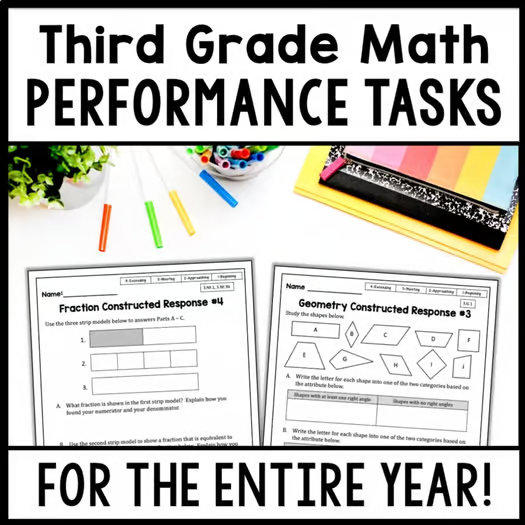
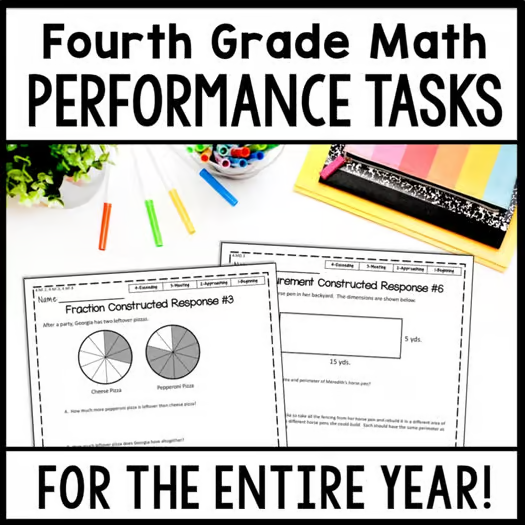
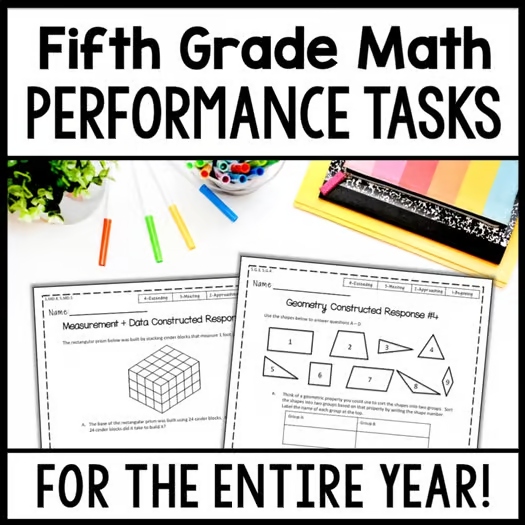
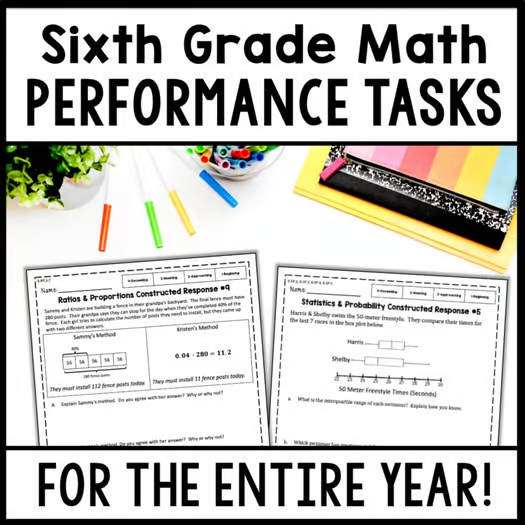
Why teachers love these bundles:
- Builds math writing, vocabulary, and critical thinking
- Helps students clearly explain their reasoning
- Prepares students for the most challenging part of state testing
- Creates a strong literacy-focused math classroom
Each performance task includes:
- The Common Core standard listed right at the top
- Plenty of space for students to show work and explain their thinking
- An easy 4-level rubric (Beginning to Exceeding) for fast grading
- A detailed answer key with point values
Final Thoughts
You don’t have to overhaul your entire math block to build a thinking classroom. Just change the questions. Pick ONE math questioning strategy from this list and try it tomorrow. I promise the conversations that follow will be more interesting than “57!”
Remember: math is so much more than having the correct answer.
Math love,
Sally 💛
FAQs
Why are questioning strategies important in math?
Because the question you ask determines the thinking you get. “What’s the answer?” gets you a number. Questions like “How do you know?” and “Is there another way?” get you reasoning, discussion, and students who actually understand what they’re doing instead of just following steps.
How do I get my students to explain their thinking in math?
Start small and make it safe. Sentence starters help (“First I… because…”), and so does explaining YOUR thinking out loud every day so they hear what it sounds like. Celebrate different methods when you see them, and give students regular chances to write about their math, not just compute. It’s a muscle, and it builds with practice.
What is a math performance task?
A performance task is a multi-step problem that asks students to solve, show their work, AND explain their reasoning in writing. Unlike a multiple choice question, there’s no guessing their way through it. It’s the same format as the most challenging sections of state tests, which is exactly why students need practice with them all year, not just in April.
When should I start preparing students for state testing?
Way before test prep season! If students only see performance tasks in the weeks before the test, the format itself becomes a hurdle. Weave them in from the beginning of the year and by spring, explaining their reasoning is just something your students do.