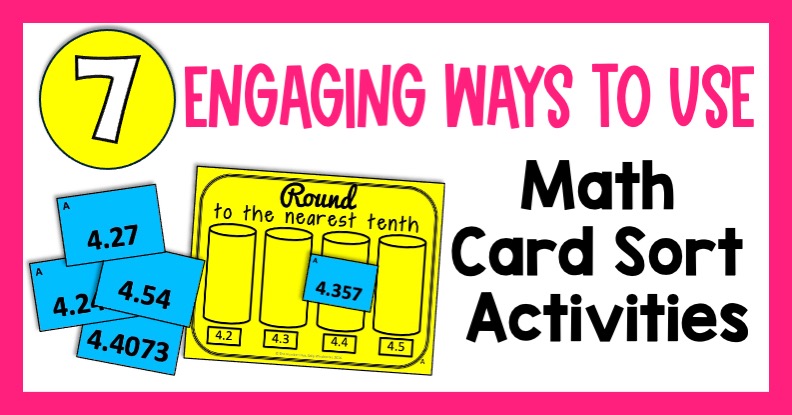
Looking to spice up your math block? Math card sort activities are a great way to reach your kinesthetic learners and the students who are slow to get going on written worksheets. Why? Because sorting number cards has a much lower barrier to entry than picking up a pencil and writing out answers.
Many upper elementary (and even middle school) students are slow to write answers out. In the same amount of time, a math card sort gets you far more “at bats” than a worksheet would.
Sounds like a win-win? It gets better! The ways you can use these are pretty much endless.
Table of Contents
What is a Math Card Sort Activity?
A math card sort is a hands-on activity where students match, order, or categorize number cards instead of writing answers on a worksheet.
There are two main types: matching games and sorting games.
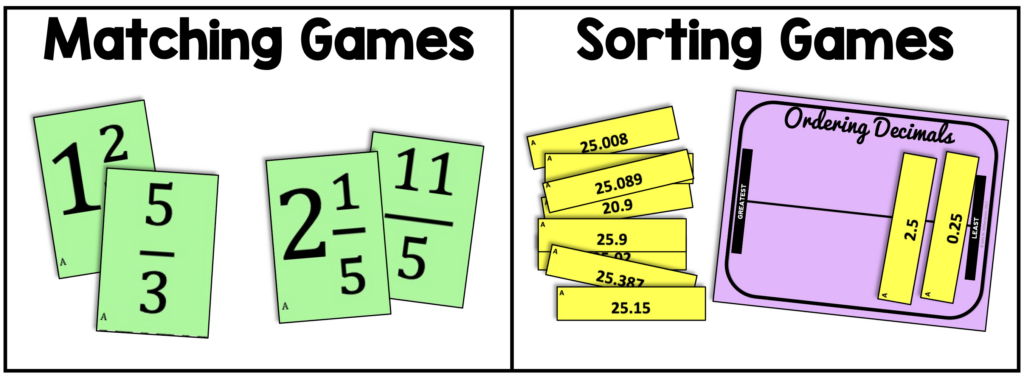
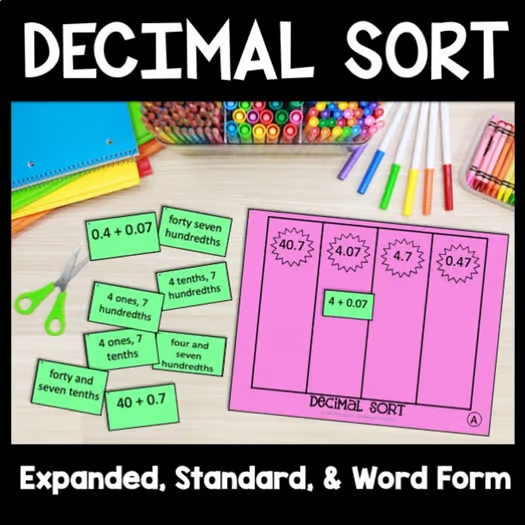
A matching game is just what it sounds like — students find equivalent pairs or groups. This works with any topic where a number has more than one form.
Potential topics for a matching game:
- Equivalent fractions
- Mixed numbers and improper fractions
- Standard, expanded, and word form
- Exponents
- Equivalent expressions (combining like terms, distributive property)
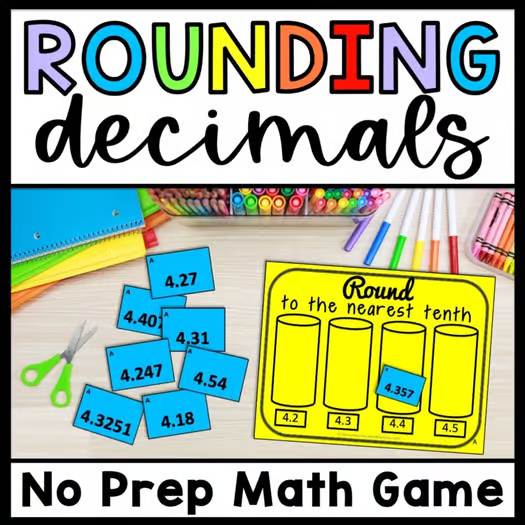
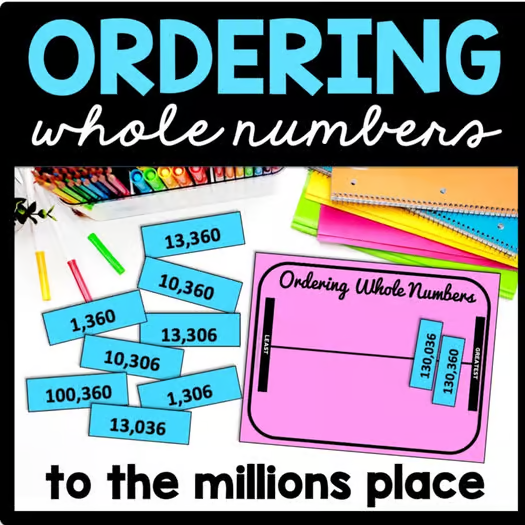
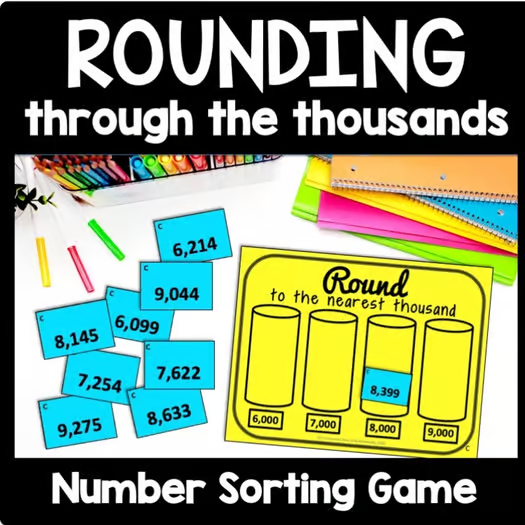
In a sorting game, each student gets a deck of cards and a game mat. They sort the cards into categories or order them from least to greatest. This works for any topic students can reason through mentally.
Potential topics for a sorting game:
- Word problems (sorted by operation)
- Ordering whole numbers, decimals, or fractions
- Rounding whole numbers or decimals
- Common factors and multiples (Venn diagram style)
- Prime vs. composite numbers
- Geometric shapes (sorted by properties)
Regardless of grade level or topic, the list goes on and on — and all you need is a deck of blank notecards.
Does math card sort activities work for any lesson topic?
Sadly, no.
Math card sort activities really only work for skills kids can do quickly and in their heads. You wouldn’t want to use one for subtracting with regrouping or adding unlike fractions. Multi step algorithms where students need to slow down and perform meticulous calculations just don’t fit this format.
For those topics, check out my post on Independent Practice Ideas for Math, which covers activities built for the more complex skills that kids can’t work out mentally.
7 Ways I Use Math Card Sort Activities in my Math Classroom
1️⃣ Musical Chairs
Place one round of a math card sort on each desk. Each round should have somewhere between 5 and 16 “at bats.” This could be pairs of numbers students have to match or individual cards they have to sort. Tuck an answer key inside each desk.
Play some silly music and let students dance around the room. Get a little crazy here. When the music stops, everyone stands behind a desk and completes that math card sort. Each round should take no more than a minute or two, and students who finish early can check over their answers.
Once it looks like most kids are done, they pull out the hidden answer key and check their work. They ask any questions they might have and then return the answer key to its hiding place. Finally they shuffle up the cards for the next person (kids love this part).
Then start the music and repeat for as long as time allows.
Students will come into contact with the same round more than once, and that’s by design. The second pass is where they build confidence and fix the mistakes they made the first time around.
2️⃣ Solve & Pass
This is another whole group option, except the papers move instead of the kids. If the idea of your students dancing around the room gives you nightmares, this one is for you.
Students stay seated. Each student gets a math card sort and an answer key folded in half. They complete the sort and check their work just like in musical chairs, but instead of getting up, they paperclip the folded answer key, the shuffled cards, and the game mat together.
Be sure they shuffle the cards and refold the key before clipping so it’s still a challenge for the next student.
Then each student passes the math card sort to the person behind them, and whoever is in the back row walks theirs up to the front. You can also arrange the passing in a snake pattern, which means only one sort has to make the long trip across the room, or you can be the one to carry it (I’VE BEEN THERE).
3️⃣ Math Centers
If you already run math centers, it’s easy to sub a math card sort in as one of your stations (or all of them). Students can work through the sort as a group, or you can have four copies of the same sort waiting at the center so everyone works independently. Either way, they check their work against an answer key when they finish.
Keep in mind that most math card sorts take under five minutes. If your centers run longer than that, just provide multiple rounds of the same game.
Here’s how I keep games organized for students to access independently:
- Big manila envelope
- Game mat inside
- Shuffled cards clipped together
- Answer key folded inside a small envelope
4️⃣ Partner Sort & Check
This is probably the way I use math card sorts the most. One student completes the sort while the other holds the answer key. The student with the key offers encouragement, gives hints, and steers their partner away from mistakes without giving anything away.
Once the solver has finished, the pair checks the answer key together.
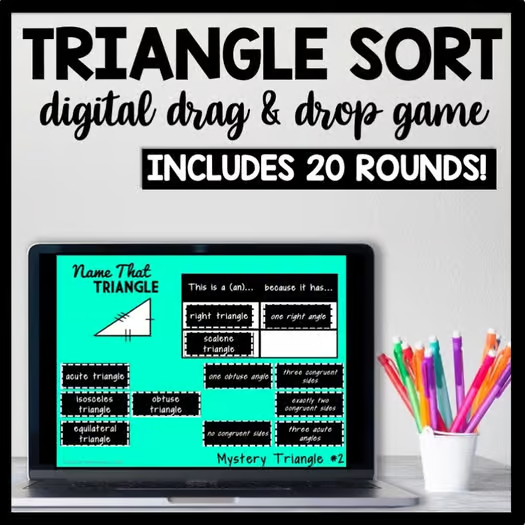
5️⃣ Digital drag and drop on smart board
This one is great as a whole class activity when you finish your lesson early. Project the number sort, invite kids up one at a time, and have each student drag a number into place. The rest of the class gives a thumbs up or thumbs down to show whether they agree.
To make your own digital drag and drop, take screenshots of individual numbers, shapes, or word problems and paste them into a Google Slides file. Then you can move the images around on the slide.
Or, if that sounds like a pain, I have about a million ready for you to use.
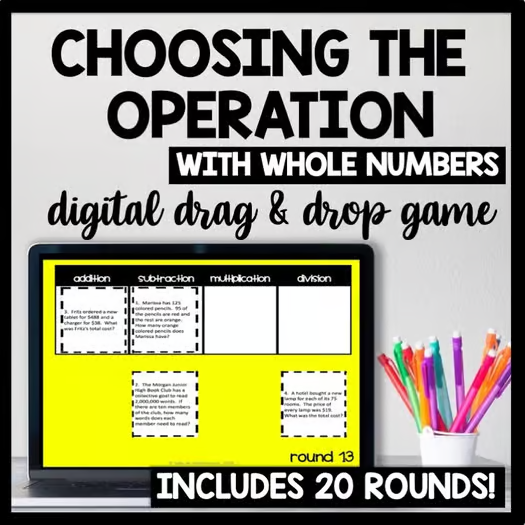
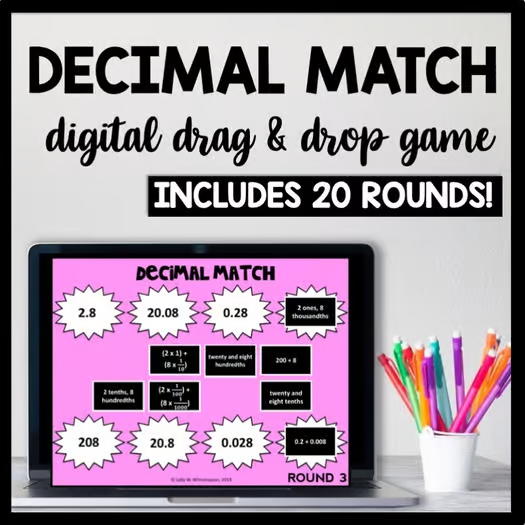
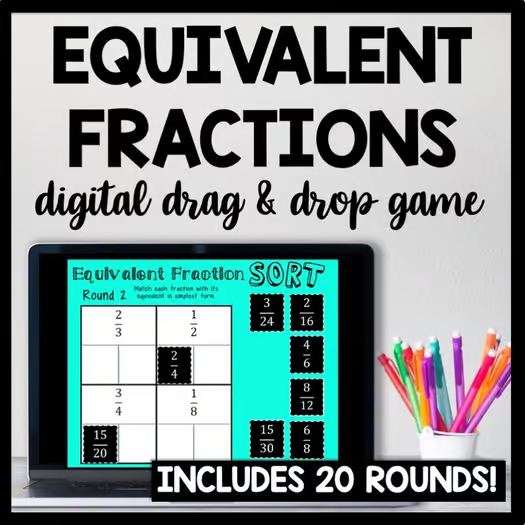
Here are a few best-selling Digital Math Card Sorts:
6️⃣ Take home cut and paste activity
Send each student home with a game mat and a sheet of cards. They cut the cards apart, complete the sort at home, and paste everything down onto the mat.
For a matching game, include a blank sheet of paper, since students will be pasting their pairs or groups side by side rather than into categories.
Lesson I learned the hard way: be sure the pre-cut cards are shuffled and not the same as your answer key. Or their isn’t really much sorting involved.
7️⃣ Early finisher bins
Set up a designated spot in your room where early finishers can grab a manila envelope and complete a math card sort activity on their own. They check their own work with the answer key inside. Just be sure they shuffle the cards and return the key to its small envelope before putting everything back.
The organization here goes one step further than what I use for centers:
- A box, tray, or shelf holds all the envelopes for one game (say, Equivalent Fractions)
- Inside the box, one manila envelope per round
- Inside each envelope, shuffled cards, a game mat, and an answer key in a small envelope
It’s worth having several games ready at once, because the same handful of students will finish early nearly every day. If you set up 5 games with 10 rounds each, that’s 50 early finisher activities, which will keep them busy for a good long while.
Ok Sally, this sounds like a lot of work to create.
Don’t worry, I’ve got your back. I’ve created hundreds of math card sorts and logged thousands of hours so you don’t have to.
Every set comes with the shuffled number cards ready to print (separate from the answer key), so kids can do the cutting for you without seeing all the answers. Best of all, each one includes 10 to 20 rounds of practice, which means you can set it out and not think about it again for weeks.
Think about what that could do for your students, especially the ones who need a little more movement in their day.
Check out my printable math card sort activities here:
- 4th Grade Math Card Sort Activities
- 5th Grade Math Card Sort Activities
- Upper Grade Math Card Sort Activities
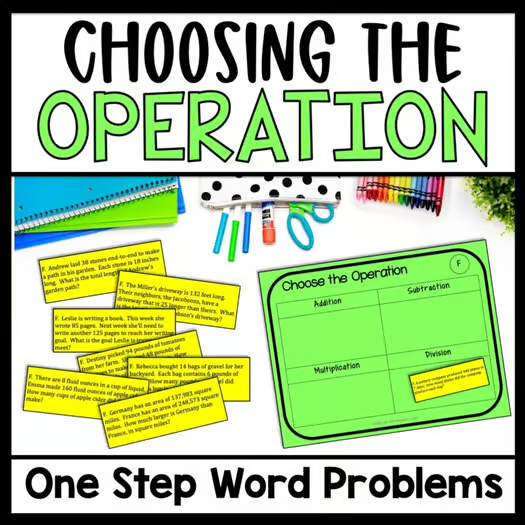
Or peruse some of my best-selling games here:
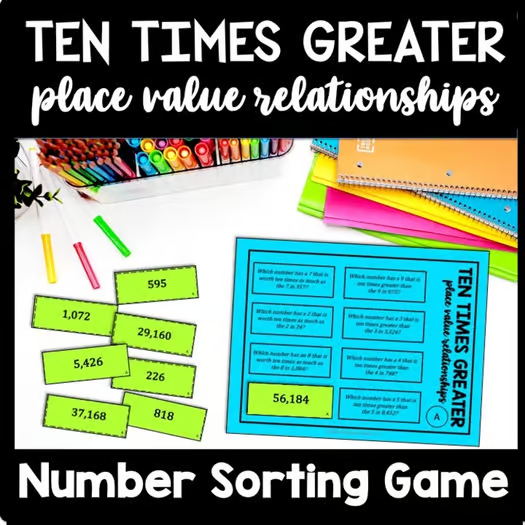
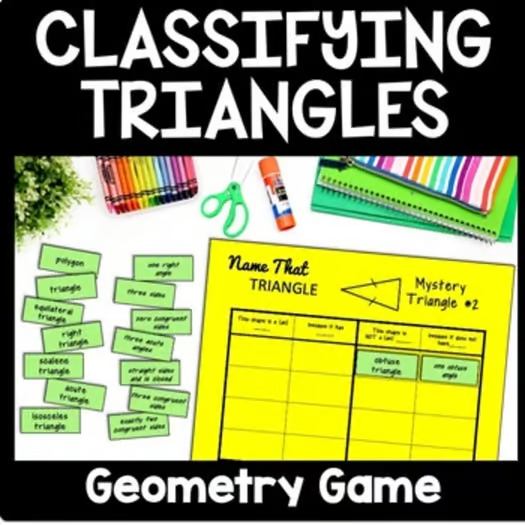
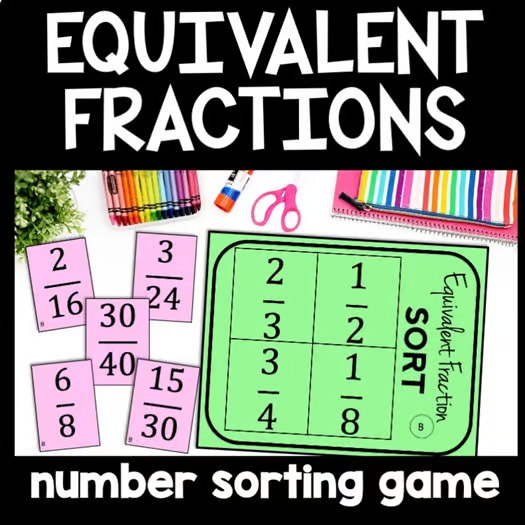
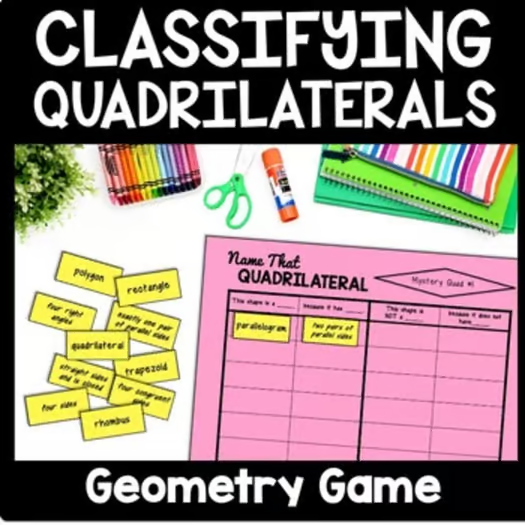
A few tips for making math card sorts more manageable:
- If you make your own sorts, put the Round letter (I prefer letters to numbers so it doesn’t get mixed up the math) in tiny writing on every corner. That way if you find a random card you know where it goes.
- Print on cardstock and then laminate so you can reuse them every year.
- Laminate before cutting, or you cut twice (learned this the hard way)
- When at all possible, have students cut. Yes, I know they struggle. Yes, I am also Type A. But your time is PRECIOUS! They can cut out ten little cards.
- If little slips of paper make you feel insane, consider trying out my Digital Drag & Drop Games. No cutting involved!
A few final thoughts on Math Card Sort Activities:
Here’s what keeps me coming back to math card sorts: the math changes, but the procedure doesn’t. Which means after you teach these activities once, it’s plug and play!
The cards themselves are simple. What makes them work is that a student can hit the same skill seven different ways in a week, dancing to it on Monday, coaching a partner through it on Wednesday, and pasting it into a homework mat on Friday. That’s a lot of repetition without any of it feeling like repetition.
You don’t need all seven of these. Pick the one that fits the classroom you actually have. If your kids need to move, start with musical chairs. If the thought of that makes you want to hide in the closet, start with solve and pass. If your centers are already running, sub a sort in tomorrow and see how it goes.
Start with one topic, one deck of notecards, and one class period. That’s genuinely all it takes to see the magic!
Math love,
Sally 💛
Math Card Sort Activity FAQs
What grade levels do math card sort activities work for?
I use them in upper elementary and they work just as well in middle school. The format itself is grade neutral. What matters is picking a skill students can do mentally, so a second grader sorting even and odd numbers and an eighth grader matching equivalent expressions are getting the same benefit.
How long does one math card sort activity take?
Most take under five minutes. If you need to fill more time than that, run multiple rounds of the same game rather than stretching one out.
Should I laminate the cards?
For anything living in a center or an early finisher bin, yes. Those get handled constantly and paper cards will be soft and torn within a month. It is time consuming to laminate these games, but means you only have to do it once!
What stops students from peeking at the answer key?
Honestly? Nothing, and some of them will. I’ve made peace with this. A student who peeks still reads the card, still sees the correct pairing, and still gets the exposure. If it becomes a pattern with a particular kid, that usually tells you the sort is too hard for them, not that they’re being sneaky.
How do I differentiate?
The easiest way is to hand out different rounds rather than different activities. Everyone is doing “equivalent fractions,” but some students get the round with halves and fourths while others get the round with sevenths and ninths. Nobody can tell from across the room, which matters more than you’d think.
Can I use these with students who have IEPs or students learning English?
They tend to be a good fit for both. There’s very little text to decode, the answer key gives immediate feedback without waiting on you, and a student who struggles to produce written work on demand can still show what they know by moving a card. Pair that with the partner coaching format and you get built in language practice too.
How often should I use them?
Once or twice a week, or even every day! Because the math changes and their are so many different ways to use them, I’ve honestly never seen kids get bored.
What if I don’t have a smart board?
Skip idea number five. The other six need nothing but paper.
Do I have to prep all 50 math card sort activities before I start?
Please don’t. Build the collection one unit at a time. Make the sorts for whatever you’re teaching this month, keep them, and by spring you’ll have a shelf full without ever having spent a weekend on it!