
Yes, I know. You teach 5th grade (or 6th grade or 8th grade or 10th grade). Kids should have learned subtracting with regrouping in 2nd and 3rd grade. And for some reason. They still struggle.
The thing is- they did learn subtraction with regrouping. They just didn’t have strategies and tools to help it stick.
That all changes now!
Table of Contents
Tip #1: You Are NEVER Too Good at Math to Count on Your Fingers
Let me say this louder for the people in the back:
You are NEVER too good at math to count on your fingers.
Never.
Not sure about 13 – 7?
Grab 7 in your fist and count up to 13.
8… 9… 10… 11… 12… 13.
How many fingers are up?
Done.
And no, this isn’t “baby math.”
This is smart math.
Because calculation errors are calculation errors whether you are:
- Solving a one-step subtraction problem
- Working through long subtraction with regrouping
- Subtracting fractions
- Solving algebra
- Finding distances on a number line
One tiny subtraction mistake can wreck an entire problem.
So if using your fingers helps you calculate accurately?
USE THEM.
I promise mathematicians care a whole lot more about correct reasoning than looking sophisticated while making avoidable errors.
I think we accidentally shame kids out of using tools that actually help them.
Meanwhile, adults use tools constantly:
- calculators
- scratch paper
- spreadsheets
- counting on fingers when nobody’s looking 👀
Finger counting is just another strategy.
And for many students, it’s an extremely effective one.
So normalize it.
Encourage it.
And maybe even use your own fingers in front of students once in a while.
Thank you for coming to my TED Talk.
Tip #2: Spend Time in Expanded Form
Before you ram the subtraction with regrouping algorithm down students’ throats, spend some time building number sense with expanded form.
Seriously.
Expanded form helps students understand the WHY behind regrouping instead of just memorizing a list of mysterious steps involving crossing things out, borrowing, and “giving numbers” to each other.
Let’s look at:
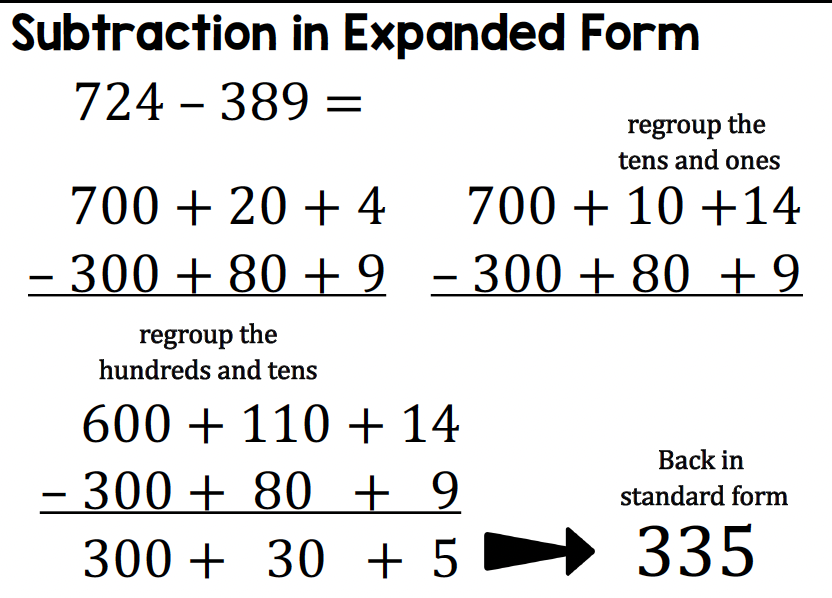
724 – 389
In expanded form, that becomes:
724 = 700 + 20 + 4
389 = 300 + 80 + 9
Now students can actually think about the value of the numbers they’re working with.
Start with the ones place:
4 – 9
Can I take 9 away if I only have 4?
No ma’am.
So what can we do?
Take 10 from the 20.
Now instead of:
20 + 4
we have:
10 + 14
And the ones place becomes:
14 – 9
(And guess what? Finger counting works beautifully here.)
Grab 9 in your fist and count up to 14:
10… 11… 12… 13… 14
Five fingers.
14 – 9 = 5
Now let’s look at the tens. We only have 10 left, and we need to take away 80.
10 – 80
Nope. Not happening.
Same move, one place over. Take 100 from the 700.
Now instead of:
700 + 10
we have:
600 + 110
And the tens become:
110 – 80
Count by tens:
90… 100… 110
Three fingers = three tens.
110 – 80 = 30
Now finish the hundreds:
600 – 300 = 300
Put it all together:
300 + 30 + 5 = 335
Done.
And do you see how much clearer that feels compared to:
- crossing random digits out
- drawing arrows
- “borrowing”
- “giving the 1 next door”
Expanded form keeps the focus on PLACE VALUE.
Students can actually see:
- what is being regrouped
- where the value comes from
- why the algorithm works
And when students understand the WHY, the standard algorithm for subtraction with regrouping suddenly makes a whole lot more sense later on.
Tip #3: When zeros make you want to pull your hair out, use the box method!
Believe it or not, 2nd graders can often solve a problem like 300 – 5 better than third through sixth graders. Wait… what?! How could that be?
It’s because the standard algorithm for subtraction with regrouping is introduced in 3rd grade. And while it works most of the time, it starts to break down when zeros enter the chat. 😬
Allow me to introduce… 🥁
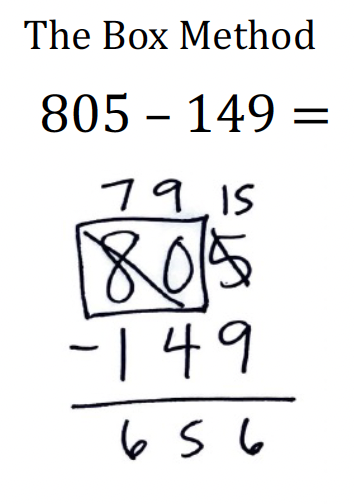
The BOX METHOD of Regrouping!
When I first discovered this method, it was love at first sight. 💘
Ok what am I looking at?
- It’s really hard to regroup a zero.
- Instead we think of it as one value: 80.
- We box the 80 and ask, what’s 1 less than 80? 79
- Then 5 becomes 15 and we are ready to go in ONE STEP!
It’s a quick, visual strategy that’s easy to teach, and it helps students subtract with zeros and actually get the right answer. Game-changer!
Need to see it action?
👉 Here’s a short video walking you through this method step by step.
Still need more subtraction support?
I designed this 5-Day Catch Up Unit for anyone in fourth grade and up who should have learned subtraction with regrouping but just… didn’t quite master it.
It starts from basic 2-digit subtraction and lays a strong foundation through expanded form. Then it moves into the tougher stuff, like word problems and subtracting with zeros.
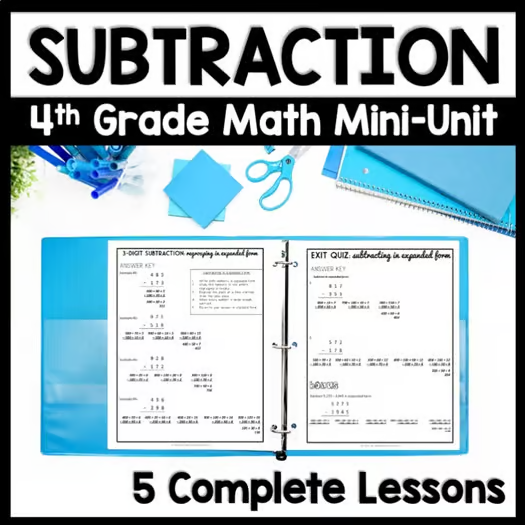
It starts from basic 2-digit subtraction and lays a strong foundation through expanded form. Then focuses on more difficult skills like word problems and subtracting with zeros.
All 5 lesson packets include:
- Teacher Lead Expamples
- Partner Practice
- Independent Practice (3 pages!)
- Challenge Page for Early Finishers
- Exit Quiz
If your students are still struggling with subtraction, it doesn’t mean they’re behind forever, and it definitely doesn’t mean you’re doing anything wrong. It just means they need the WHY, not another round of the same steps that didn’t stick the first time.
So let them count on their fingers. Slow down and play in expanded form. Pull out the box method when zeros show up. Small shifts, big payoff.
Your students can do this. And so can you.
Math love,
Sally 💛
Isn’t finger counting a crutch?
Nope. Nopety nope nope. It’s a tool, just like a calculator or scratch paper. Accuracy matters more than looking impressive, and most kids drop the fingers naturally once the facts become automatic. Shaming them out of it just trades correct answers for silent guessing.
What grade levels are these strategies for?
Anyone who is still making subtraction with regrouping errors, honestly. I’ve used them with 4th graders through middle schoolers. The strategies meet students where they are without feeling babyish.
Do I still need to teach the standard algorithm?
Yes! These strategies aren’t a replacement, they’re the foundation. Once students understand what regrouping actually does, the standard algorithm stops being a mystery and starts being a shortcut.
How long should I spend on expanded form?
Less time than you’d think. Even a few days of expanded form practice can unlock the place value understanding students were missing. When they can explain WHY they’re regrouping, they’re ready to move on.
What if my students still struggle after all this?
That’s exactly what the 5-Day Catch Up Unit is for. It starts at 2-digit subtraction and builds up step by step, so students fill the gaps in order instead of jumping straight to the hard stuff. Let’s master subtrction with regrouping once and for all!