
Is it just me, or does choosing the operation in word problems suck the life right out of a classroom?
My students can multiply like champs.
They just don’t always know when to multiply.
And when all four operations get thrown into the mix?
👉 Total. Disaster.
Suddenly, everything they’ve learned seems to vanish into thin air.
Here’s the good news, though: choosing the correct operation in word problems isn’t a “you either get it or you don’t” skill. It’s teachable. And with the right strategies, it becomes a lot more manageable for your students.
Let’s fix it.
Table of Contents
Why are word problems so hard for kids?
Word problems don’t just test computation. They test reading and decision-making.
And here’s something we don’t talk about enough: many of our students are reading below grade level. That doesn’t stay in the ELA block. It trickles right into math the moment a problem shows up in paragraph form.
Even when students know the computation, they struggle to read and interpret what the problem is asking. They get overwhelmed when multiple operations are possible.
So the breakdown isn’t math. It’s reading and interpretation.
That means we need to explicitly teach students how to choose the operation in word problems, not just how to solve.
Hack #1: Teach “Choosing the Operation” in Isolation
Choosing the operation in word problems is a skill all on its own.
So don’t always bundle it with solving.
👉 Try this instead: Give students a set of word problems and ask ONLY one question:
What operation would you use?
That’s it. No solving.
Why it works:
- More focused thinking
- More practice in less time
- Less cognitive overload
- Better buy-in from struggling students
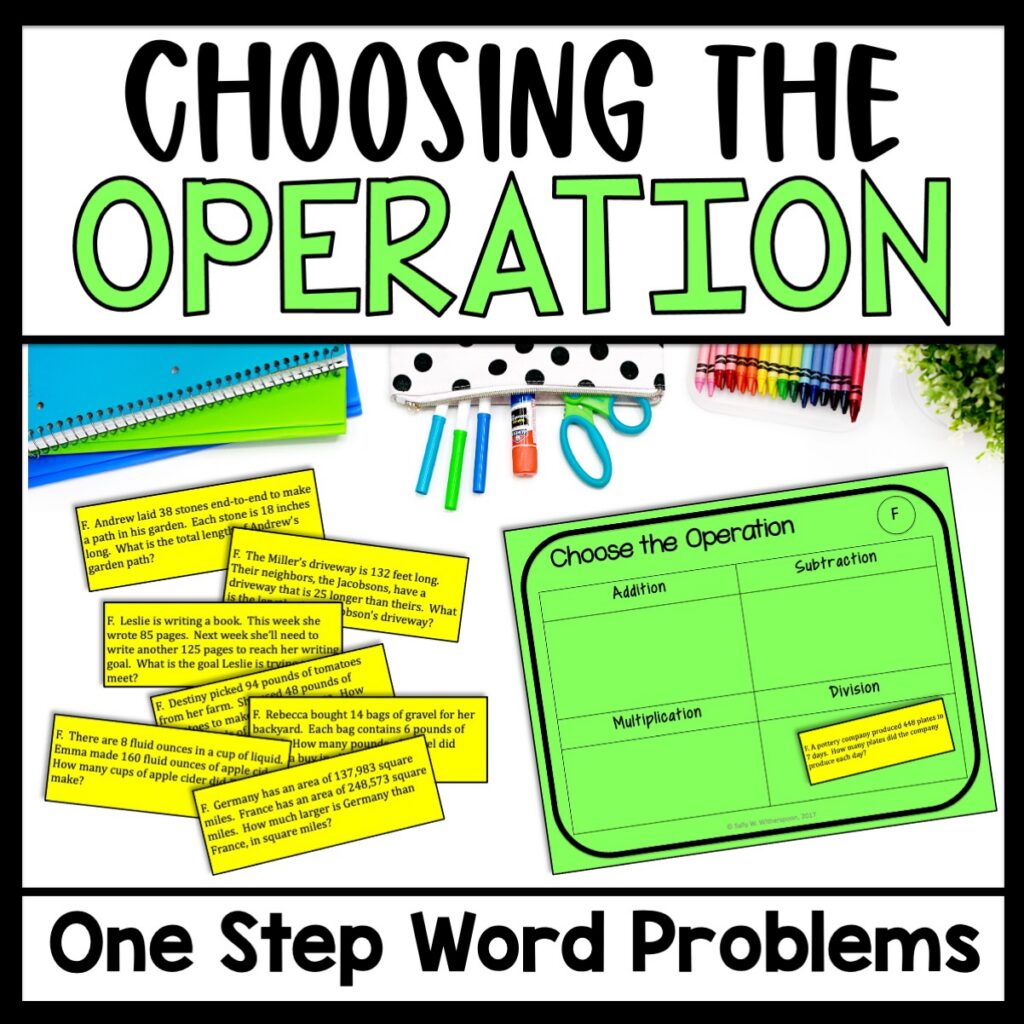
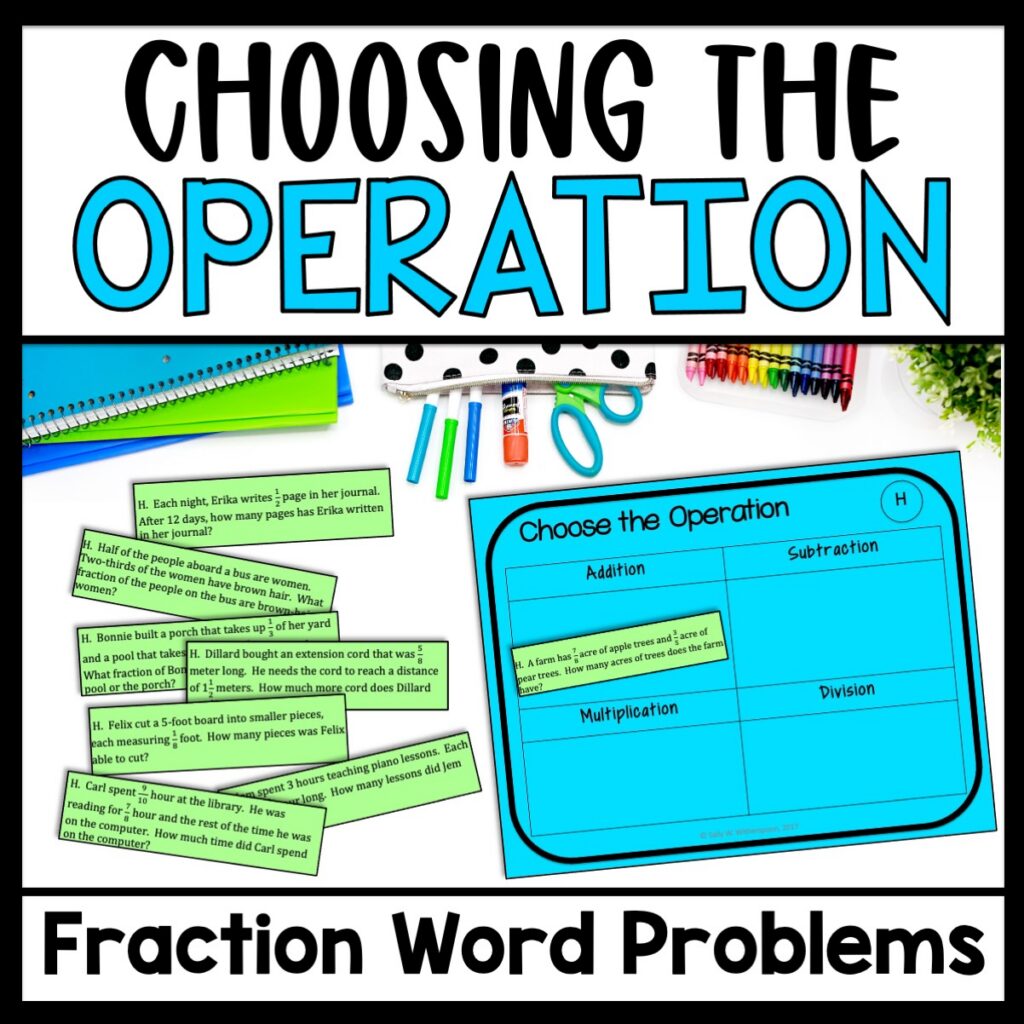
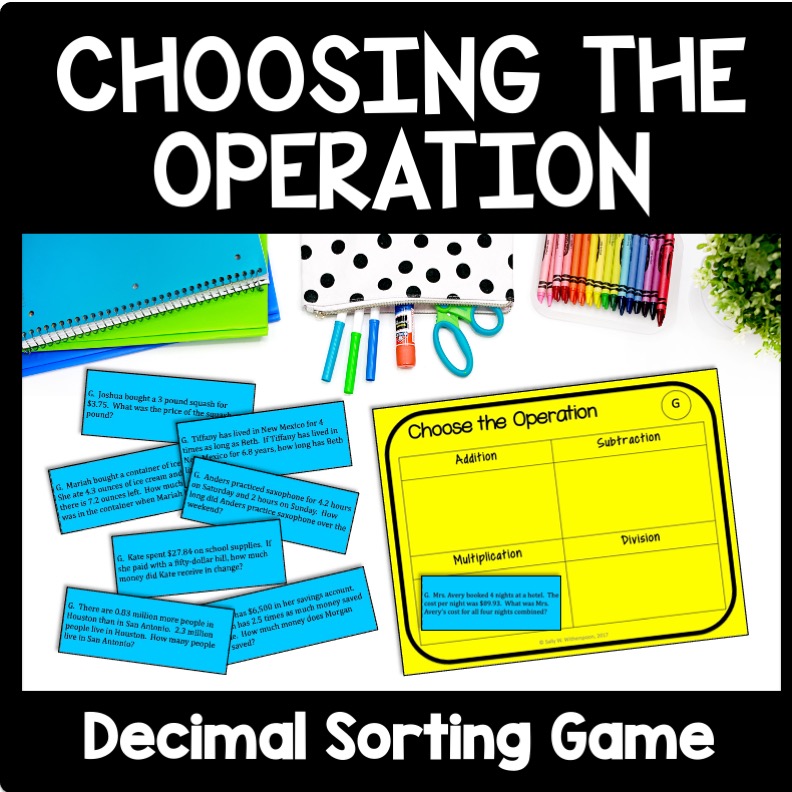
This one small shift creates a whole lot more success. And I have an entire game I created just to give students quick “at-bats” for choosing the operation. It’s a great way to make it fun and remove the stress that “solve” brings to the table!
Hack #2: Stop Relying on Keywords
Keywords are sneaky. And often flat-out misleading.
Words like:
- “total”
- “left”
- “in all”
can show up in problems for any operation, not just one.
So instead of teaching keyword lists, teach students the definitions of the four operations:
- ➕ Addition means combining groups
- ➖ Subtraction means taking some out of an existing group or finding the difference
- ✖️ Multiplication means repeated groups of the same amount.
- ➗ Division means splitting a group into smaller equal groups.
Then we ask them 👉 What is happening in this problem?
Focus on meaning, not memorizing.
Hack #3: Narrow It to Two Operations at a Time
Four operations at once is just too much for many learners.
So instead:
👉 Start with just two (commonly mixed up) operations at a time.
These lesson packets narrow the focus to make it feel more accessible to students.
Why this works:
- Reduces confusion
- Builds confidence
- Lets patterns emerge
Once students are solid with one comparison, add the next layer and try three operations.
Start small. Build intentionally.
Hack #4: Pay Attention to Labels
Labels are one of the most underrated clues in word problems.
Ask students
👉 Are the labels the same or different?
A helpful trick is to look at the units or labels in the problem.
- If the problem involves two different labels (like pencils and boxes), it’s probably NOT addition or subtraction. We don’t add pencils + boxes!
- If the labels are the same or very similar, it’s likely addition or subtraction.
- If the labels in the problem are the same, but the answer will have a new label, it’s probably division.
“49 pencils are split into groups of 7 pencils. How many groups can we make?”→ Same label in the problem (pencils), new label in the answer (groups) → That’s division!
Hack #5: “Each,” “Every,” and “Per” Are Clues
Each, every, and per signify repeated groups, which means probably multiplication or division.
But how do we know which on it is?
Then teach students to ask:
👉 Do I have the total or am I trying to find it?
👉 Will the answer be bigger or smaller than the numbers I started with?
- If bigger → likely multiplication
- If smaller → likely division
This helps students reason instead of guess.
Want More Support? Here’s a Full Unit
If word problems feel like a constant struggle, you’re not alone. And you don’t have to piece it together from scratch!
I created a full unit focused specifically on this skill:
🎉 Sally’s 10-Day Choosing the Operation in Word Problems Unit
It includes:
- 80+ pages of instruction and practice
- Step-by-step skill building
- Focused practice on operation selection
- Assessments to track growth
This is all about making word problems feel predictable instead of overwhelming.
Free Resource to Try First
Want to test these strategies with your students?
Here’s a free starting point:
🎁 Choosing the Operation: Addition vs. Subtraction (FREEBIE)
- Focused practice
- Teacher guidance included
- Exit ticket included
- Perfect for introducing the concept without overload
Final Thoughts
Choosing the operation in word problems doesn’t have to feel like chaos.
When students learn to focus on meaning and recognize patterns, everything starts to click.
Remember, you’re not just teaching math. You’re teaching problem-solving.
And good problem-solvers are something this world needs more of, right?
Math love,
Sally 💛
FAQs
Q: Should I stop teaching keywords completely?
A: Not necessarily. Keywords can be one clue, but they should never be the strategy. Teach students to ask “What is happening in this problem?” first, and let keywords play a supporting role at most.
Q: How long should I spend on “choosing the operation” before adding solving back in?
A: There’s no magic number, but even 5 to 10 minutes a few times a week makes a difference. Once students can explain why they chose an operation, they’re ready to solve again. The explanation is the real checkpoint.
Q: What if my students are reading below grade level?
A: You’re not alone, and this is exactly why word problems fall apart for so many kids. Read problems aloud, keep the numbers simple while they practice choosing, and let them act out or sketch what’s happening. The goal is interpreting the situation, not decoding the text.
Q: Which two operations should I pair first?
A: Start with addition vs. subtraction (I have a FREE LESSON!), since the situations are the most familiar. Then move to multiplication vs. addition. Multiplication vs. division can feel the most daunting to kids because they are more abstract concepts and are harder to visualize.
Q: How do I fit this in when my pacing guide is already packed?
A: Make it a warm-up, not a whole lesson. One problem, one question: “What operation would you use, and how do you know?” Two minutes a day beats one big review week before the test.
Q: Does this work for multi-step word problems too?
A: Yes! Multi-step problems are really just several “choose the operation” decisions in a row. Students who are strong at choosing one operation have a much easier time breaking a bigger problem into steps. Several multi-step word problem lessons are included in my “Choosing the Operation in Word Problems” 10-Day Unit.