Table of Contents
1. Levels 1, 2, 3
This game is a powerhouse for scaffolded independent practice. Create three levels of problems (Easy, Medium, and Hard) each designed to take no more than five minutes.
- How it works: Answer keys are taped around the room. I fold them in half to prevent wandering eyes. Students work at their own pace, holding up fingers to show which level they’ve finished. You give them a thumbs up and they find the corresponding key to check their own work. If their work is correct, they move on; if not, they go back and fix their mistakes.
- Best for: Tricky skills like long division, multi-step word problems, or adding fractions with unlike denominators.
- Why it works: It creates a sense of urgency while letting higher-level students reach for the challenge of Level 3 and giving students who need it focused practice on Level 1. It allows you to intervene early with students who are struggling with the easiest Level 1 problems
2. Clipboard Dash
If you want to get your students moving, this is the game for you. It turns a standard problem set into a high-energy treasure hunt.
- How it works: Hide 24 numbered problems around the room in obvious and “hidden” spots: under tables, even on the ceiling. Give students worksheet with a a grid where the numbers match the problem set. Or better yet, save yourself some copies and have students create their own! Students have 10 minutes to find and solve as many as they can on a clipboard.
- Best for: Medium-difficulty skills like rounding, simplifying fractions, or basic operations. Avoid something with too many steps or students might rush.
- Why it works: The movement and time pressure keep energy high, while the hunt makes routine practice feel like a game.
Want a set of Clipboard Dash clues done for you and ready to print? Here you go!
3. Silly to Serious
This game turns math practice into a mini dance party.
- How it works: Students work silently at their seats. Hit play on the silliest song you can find (think “Who Let the Dogs Out?”, maximum cringe, not the latest hit). Kids jump up and dance wildly, but must bring their paper and pencil with them. After about 15 seconds, pause the music: students drop into the nearest desk and immediately get to work, silent and focused, pencils flying. After a minute of laser focus, crown the Silly to Serious Champion: the student who nails both extremes, the most ridiculous dance moves and the strongest, quietest focus. Repeat as many rounds as needed to shake out the wiggles.
- Best for: Literally any math skill. And you can play it at the drop of a hat if a class starts to feel tired. That restless class right after lunch, the antsy pre-recess stretch, or the end-of-year “everyone’s over it” slump, any time you need to harness wild energy instead of fighting it.
- Why it works: It gives students a structured way to release energy without derailing your lesson, builds stamina for short bursts of intense focus, draws out even your quieter kids, and creates a shared classroom culture of silliness and connection.
- Bonus tip: let an early finisher be the “Silly to Serious Master” who runs the music and helps judge, while you grab a breather.
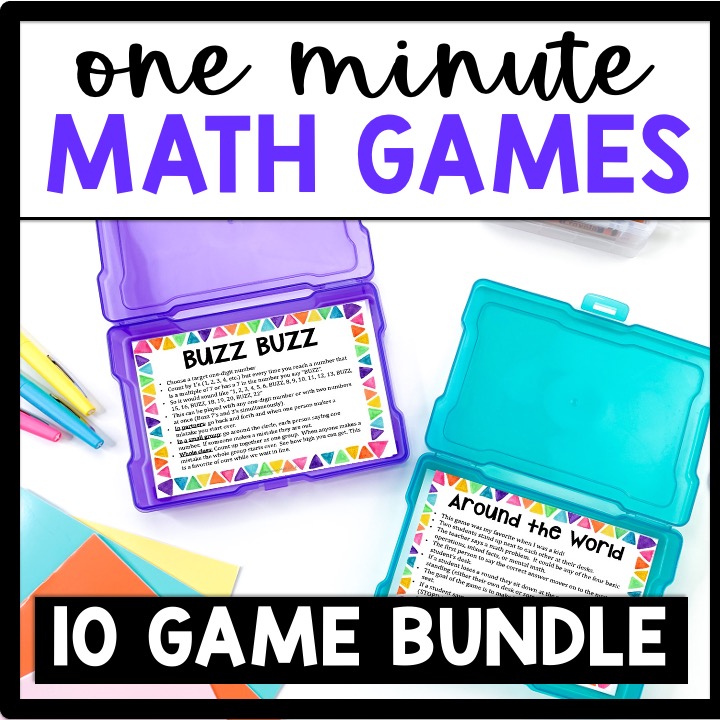
Want more back pocket math games that you can use when a class feels sleepy or you have a few extra minutes?
Say less!
Here are 10 that I use constantly!
How get a tired or restless class back on track? What are some ways you make practice more fun? Let me know in the comments!
Math love,
Sally 💛
Frequently Asked Questions (FAQs)
How much prep do these games take?
Very little. Silly to Serious needs zero prep beyond a silly playlist. Levels 1, 2, 3 just needs three short problem sets and answer keys taped up around the room. Clipboard Dash takes the most setup (hiding 24 problems), but you can cut prep by having students create their own grids instead of copying worksheets.
What grade levels do these work for?
They’re written with upper elementary in mind (think 4th and 5th grade), but every one of them adapts easily. Swap in the skill and difficulty that fits your students and the games work just as well in 2nd grade or middle school.
How long does each game take?
Plan for 10 to 15 minutes. Levels 1, 2, 3 runs about 15 minutes since each level is around 5 minutes. Clipboard Dash is a tight 10-minute hunt. Silly to Serious is the most flexible: one round takes about 90 seconds, so you can play for two minutes or ten depending on how wiggly the room feels.
Do I need to grade anything afterward?
No. These are built for independent practice and self-checking, not collecting. Levels 1, 2, 3 has students check their own work against the keys, which means they get instant feedback and you stay free to pull aside anyone stuck on Level 1.
What if I have a small classroom, or no space to move around?
They still work. Take Clipboard Dash to the hallway or outside. Silly to Serious works in any footprint since students dance near their desks. Levels 1, 2, 3 needs nothing but seats and a few walls for answer keys.
How do I keep movement games from turning into chaos?
Set the expectation before you start, not during. Name the time limit, model what “find and solve” looks like, and use the music or timer as your reset signal. The built-in urgency does most of the classroom-management work for you.
Can I use these for subjects other than math?
Absolutely. Silly to Serious works for any independent practice. Clipboard Dash and Levels 1, 2, 3 work for vocabulary, grammar, or any skill with clear right-and-wrong answers and a quick answer key.