
Table of Contents
Story time…
When we first switched to the Common Core standards back in the olden days (ahem… 2010), I thought 5.NBT.1 and 5.NBT.2 were some kind of sick joke.
Am I being punk’d? Where is Ashton Kutcher?
What do you mean 10 times greater?
ONE THOUSAND TIMES GREATER?!
And perhaps most importantly…
Why do kids even need to know this?
But the deeper I dug into the standards, the more I realized how many math concepts rely on a strong understanding of our base-ten system and place value:
✅ Decimal operations
✅ Percentages
✅ Metric conversions
✅ Scientific notation
The list goes on and on.
Not gonna lie… the first few times I taught these standards, it was a total mess. 😅
But after years of teaching powers of 10, I’ve found a few best practices that make a huge difference (and one thing you absolutely must avoid!).
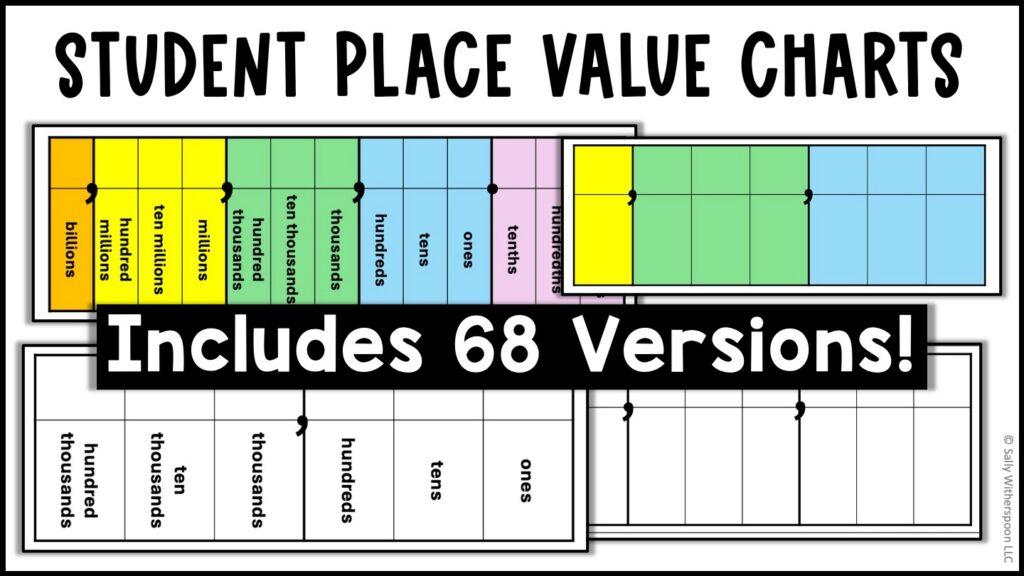
📌 Tip #1: Tape a Place Value Chart to Their Desk
Yes, I’m sure you have a beautiful place value chart poster hanging on the wall.
Yes, I’m sure you’ve had students hop around on a giant floor version as a lesson hook.
Those things are great.
But students need to be able to touch the place value chart and interact with it during every single problem.
They need to put their finger on the hundredths place and physically hop three spaces larger to the ones place.
They can’t do that with a poster across the room.
And I’m pretty sure you don’t want them jumping up and running to the floor chart every time they solve a problem. 😂
⭐ Bonus Tip
Tape the chart directly to their desks using packing tape.
Now they can write on it with a dry-erase marker all year long!
Here’s my printable version, or it’s pretty easy to make your own.
📌 Tip #2: Write Numbers in Unit Form
Big, ugly decimals can feel intimidating.
Unit form helps students break a complex problem into smaller, more meaningful pieces.
For many students, it feels much less scary to multiply 9 hundredths by 100 than to multiply 8.39 × 100.
What this looks like IRL:
8.39 × 100
First, rewrite the number in unit form:
8 ones 3 tenths 9 hundredths
Now ask:
What happens when we multiply by 100?
The number shifts 2 places bigger. (We’ll make an anchor chart for this in Tip #3.)
Using the place value chart taped to the desk:
- 8 ones finger to place value chart, hop 2 times to 8 hundreds
- 3 tenths finger to place value chart, hop 2 times to 3 tens
- 9 hundredths finger to place value chart, hop 2 times to 9 ones
Now rewrite the answer in unit form:
8 hundreds 3 tens 9 ones
Finally, convert back to standard form:
839
Students can literally see what’s happening to each digit. They won’t do this forever. And when they start to do this mentally, they will actually understand the math behind each shift.
📌 Tip #3: Create an Anchor Chart Students Can Actually Use
Keep it simple.
Multiplication
✖️ 10 → 1 place bigger
✖️ 100 → 2 places bigger
✖️ 1,000 → 3 places bigger
Division
➗ 10 → 1 place smaller
➗ 100 → 2 places smaller
➗ 1,000 → 3 places smaller
I’ve found that saying “bigger” and “smaller” clicks much more than saying “left” and “right.”
Because let’s be honest…
Some people still struggle with left and right.
It’s me. I’m people. 🙋♀️
It also reinforces what’s actually happening on the place value chart instead of turning the process into a memorized trick.
🚫 Tip #4: Stop Saying “The Decimal Moves”
Repeat after me:
The decimal does not move.
Again for the people in the back:
THE DECIMAL DOES NOT MOVE.
The decimal isn’t hopping around the number.
It isn’t sliding left and right.
The decimal stays permanently between the ones place and the tenths place.
Wholes live on the left. Parts live on the right.
When we tell students that “the decimal moves,” we rob them of the deeper understanding this standard is trying to build.
At this point you’re probably saying:
“Okay, Sally. Calm down. I get it. The decimal doesn’t move.” 😂
So what does move?
The digits move.
Every digit shifts left or right on the place value chart based on the power of 10.
Each additional power of 10 shifts the digits one more place larger or smaller.
The more comfortable students become with this concept, the easier future topics like decimal operations, metric conversions, and scientific notation will feel.
More resources for teaching Powers of 10
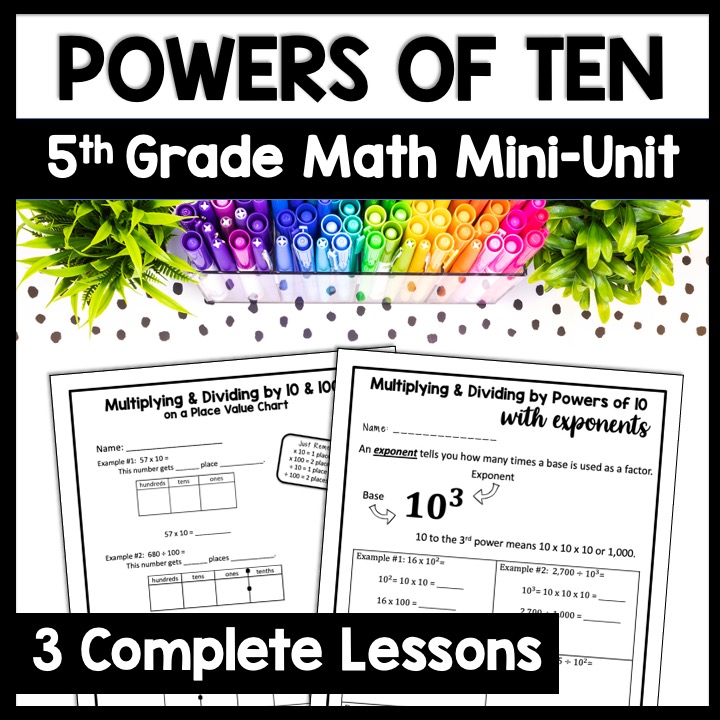
Here’s a 3-day mini unit completely on this topic! It starts with the place value chart, moves to mental math, and then introduces exponents on day 3!
I also have 3 YouTube videos where I break this concepts down live if you feel like you want to see the skills in action!
❤️ Final Thoughts
As you can see, I am unexpectedly passionate about powers of 10.
2010 Sally could NEVER.
But now I understand why this standard matters so much. It’s not really about multiplying by 10, 100, or 1,000.
It’s about helping students understand how our entire base 10 number system works.
And that’s a lesson they’ll use for years to come.
What powers of 10 tips would you add?
Math love,
Sally
❓ Frequently Asked Questions About Teaching Powers of 10
Why do students struggle with powers of 10?
Many students memorize tricks instead of understanding place value. They learn rules like “move the decimal two places” without understanding why the digits change value. Building a strong foundation with place value charts and unit form helps students develop true conceptual understanding.
What grade level teaches powers of 10?
What grade level teaches powers of 10?
Powers of 10 are formally introduced in 5th grade through Common Core standards 5.NBT.1 and 5.NBT.2. However, students begin building the foundation much earlier.
In 3rd grade (3.NBT.3), students learn to multiply by multiples of 10, such as 40 × 7. Then in 4th grade (4.NBT.1), they explore relationships such as 150 being 10 times greater than 15.
By the time students reach 5th grade, they should already understand that digits shift to different places when numbers are multiplied or divided by powers of 10. Fifth grade simply extends that understanding to larger numbers, decimals, and more complex place value relationships.
Should students memorize that multiplying by 10 moves the decimal?
No. While students may eventually recognize patterns, instruction should focus on how digits shift within the place value chart. The decimal point stays fixed between the ones and tenths places. Understanding place value leads to deeper mathematical thinking than memorizing shortcuts.
How do you teach multiplying decimals by powers of 10?
Start with a place value chart and have students identify the value of each digit. When multiplying by 10, 100, or 1,000, students move each digit one, two, or three places larger on the place value chart. Using unit form can make this process even more concrete.
How do you teach dividing decimals by powers of 10?
Division works the same way in reverse. Students move each digit one, two, or three places smaller on the place value chart when dividing by 10, 100, or 1,000. Encouraging students to think about place value rather than memorized procedures builds stronger number sense.
Why is understanding powers of 10 important?
Powers of 10 are the foundation for many future math concepts, including:
- Decimal operations
- Percentages
- Metric conversions
- Scientific notation
- Exponents
- Algebraic reasoning
Students who understand powers of 10 typically have an easier time with these topics later on.
What is unit form in math?
Unit form describes a number using place value units instead of standard notation.
For example:
8.39 = 8 ones, 3 tenths, 9 hundredths
Unit form helps students focus on the value of each digit, making it easier to understand how multiplication and division by powers of 10 affect a number.
What’s the biggest mistake teachers make when teaching powers of 10?
The most common mistake is teaching students that “the decimal moves.” While this shortcut may seem helpful, it often prevents students from understanding the underlying place value concepts. Instead, focus on how the digits move to different places on the place value chart.

2 Responses
Thanks for this helpful post!!
Hi Katie! Thanks so much!