Table of Contents
Isosceles, Scalene, Equilateral, Oh My! Right, Acute, Obtuse, WHAT?!
Let’s be honest- teaching classifying triangles can feel deceptively simple.
Until it’s not.
You explain it clearly…
You model examples…
You feel good about the lesson…
And then students start calling everything “isosceles” 😅
Or they mix up angle types…
Or forget the names entirely…
Sound familiar?
The truth is, classifying triangles is a spatial reasoning skill AND a vocabulary challenge—which is exactly why students struggle.
The good news? A few simple, hands-on tricks can make all the difference.
Why is Classifying Triangles So Tricky?
Students are juggling a lot at once:
- Identifying angle types
- Identifying side relationships
- Vocabulary words that are LONG and hard to say
- Visualizing shapes in different orientations
That’s a heavy cognitive load.
Let’s give our students some better tools to master the different types of triangles once and for.
First Up! A Crash Course in Classifying Triangles:
All triangles have two names: one based on sides and one based on angles. Think FIRST and LAST name.
The angle name is based on the type of angles it has (acute, obtuse, or right).
The last name is based on the number of sides that are congruent (equilateral, isosceles, scalene).
So a Right Isosceles Triangle is a triangle with one right angle and 2 congruent sides.
Trick #1: The Notecard Trick
This trick helps with angle classifications (AKA first names).
👉 Give each student a colored notecard.
Why it works:
- The corner of a notecard is a perfect 90° angle
Students can use it to:
- Check for right angles
- Compare other angles
How to use it:
- If the angle matches the corner → it’s a right angle
- If it’s more open → it’s obtuse
- If the notecard doesn’t fit → it’s acute
Some students will still need support using it and that’s okay. This is a tool, not a magic wand. See tips 2 and 3 for more support on angles!
Trick #2: Label-As-You-Go
Another trick for angles!
👉 Have students label each angle as they analyze it:
- A = Acute
- O = Obtuse
- R = Right
Then, once all angles are labeled:
👉 Classify the triangle.
Does it have an O or an R? That angle NAMES the triangle. All As? That means it’s an acute triangle
Also:
- Encourage students to box the corner of any right angle.
Why Trick #2 works:
- Breaks the task into manageable steps
- Reduces overwhelm
- Reminds students where the angle names actually come from. Only 3 acute angles makes a triangle acute!
Some students will drop this quickly. Others will rely on it heavily.
Both are fine.
Trick #3: Rotate Your Paper and Cover Up!
Yes, I’m sorry this is yet another trick for angles. Why? Because angles are honestly much harder. I promise the trick for sides is coming!
Some students simply can’t recognize angles unless they’re oriented a certain way.
👉 Have students rotate their paper so each angle is “flat” or parallel with the bottom of the desk. Then cover the rest of the triangle so they are JUST looking at that angle. Then immediately label it with O, R, or A.
As someone with good spatial reasoning, I don’t really know why this works. But I have seen firsthand how some kids can suddenly- SEE IT! And be able to classify an angle.
Why it works:
- Matches how angles are often introduced in early grades
- Makes angles easier to visually compare
- Supports spatial reasoning
You’ll literally see light bulbs go off.
Trick #4: The “S-I-E” Memory Hack
With classifying by sides the real struggle is just remembering these long Greek and Latin words!
Scalene.
Isosceles.
Equilateral.
For many students, this is where things fall apart.
Try this:
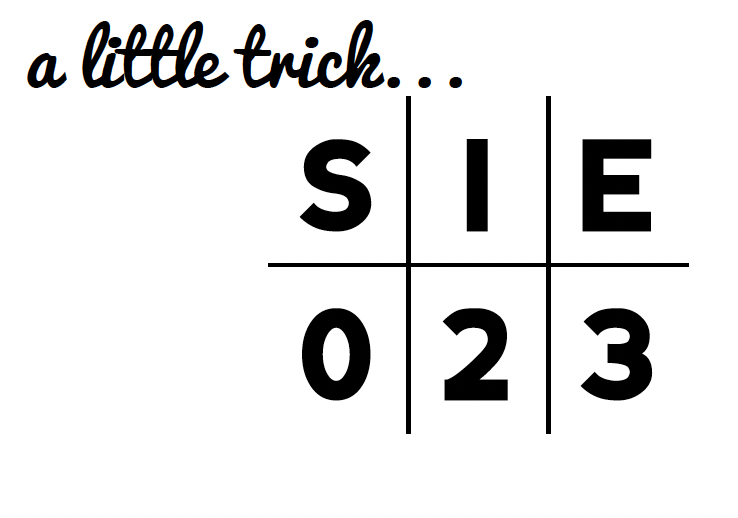
👉 “S – I – E → 0 – 2 – 3”
- Scalene = 0 equal sides
- Isosceles = 2 equal sides
- Equilateral = 3 equal sides
Have students write this in the margin. Like this:
And then say it with a little beat- “S-I-E” clap, clap, clap “Zero-Two-Three” clap, clap clap
Why it works:
- It’s short
- It’s memorable
- It gives students a quick reference
On a multiple choice test, the first letter is really all the need.
The Big Idea: Names Don’t “Match”
This is the concept that trips students up the most.
👉 Angle names and side names are independent.
That means:
- A triangle can have both a side classification and an angle classification
Examples:
- Right scalene
- Right isosceles
- Acute equilateral
Students often assume:
👉 “There’s only one name per triangle”
Make it explicit:
These are two separate categories that combine.
Once this clicks, everything gets easier.
Resources for classifying triangles…
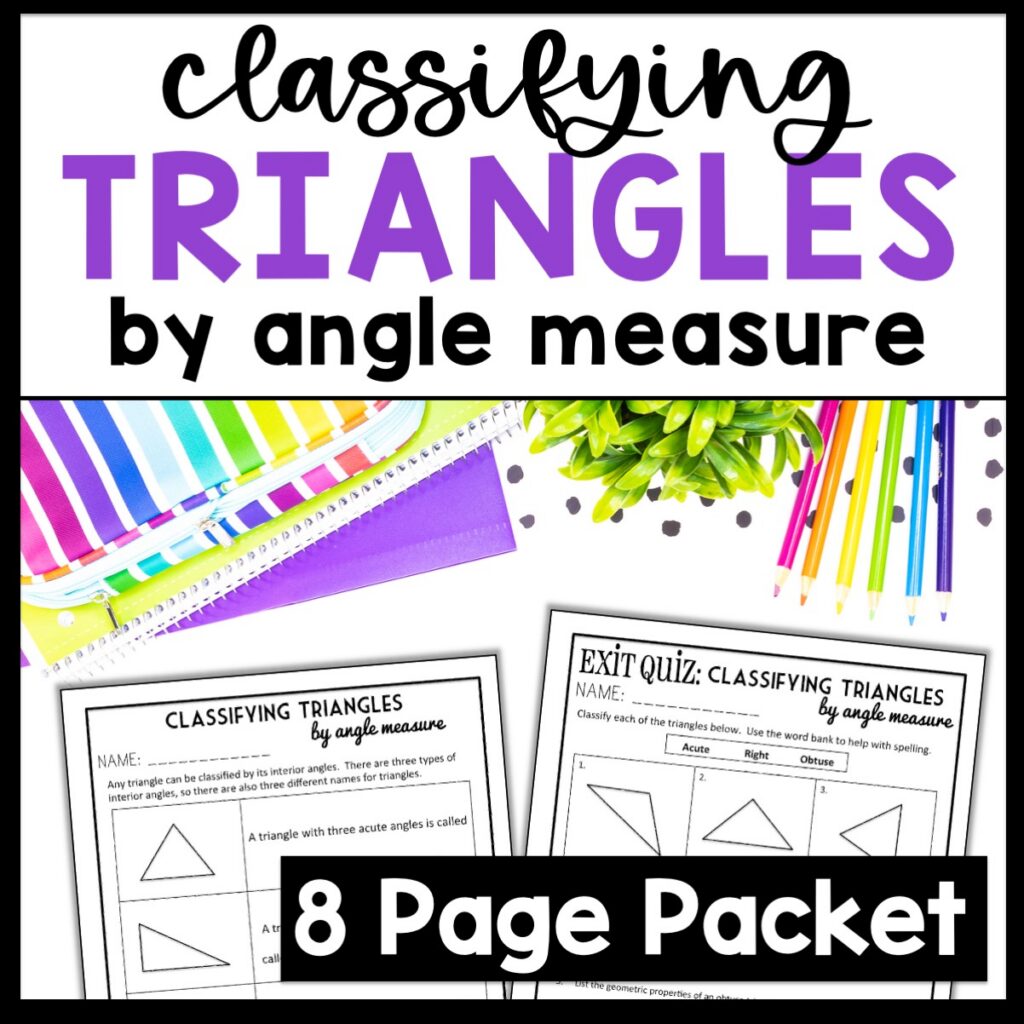
Want to put these strategies into action? Guess what! This first lesson “Classifying Triangles by Angle Measure” is COMPLETELY FREE!
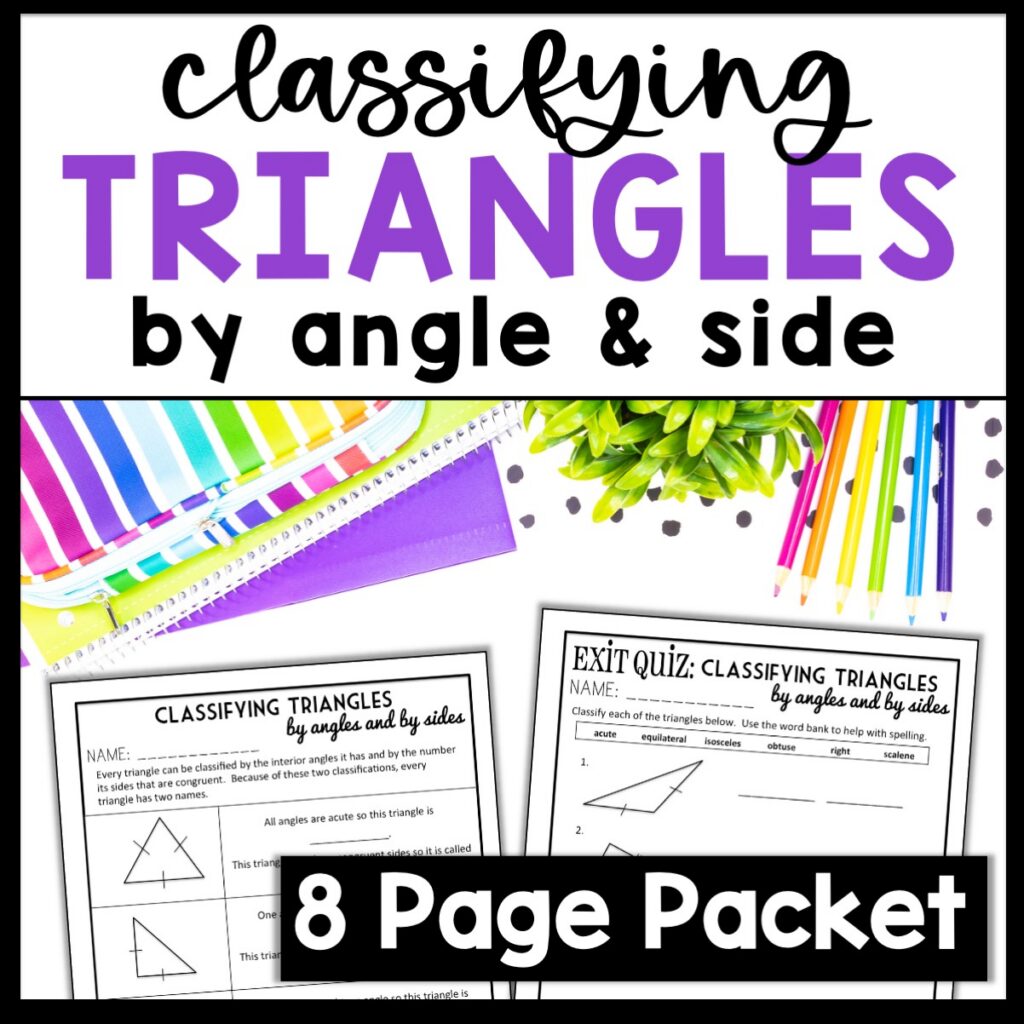
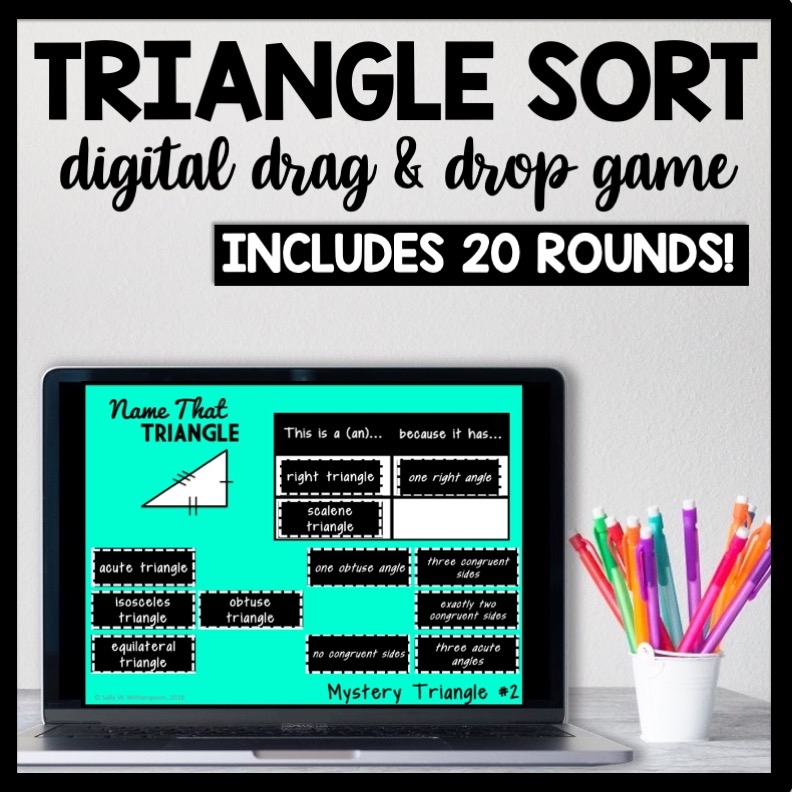
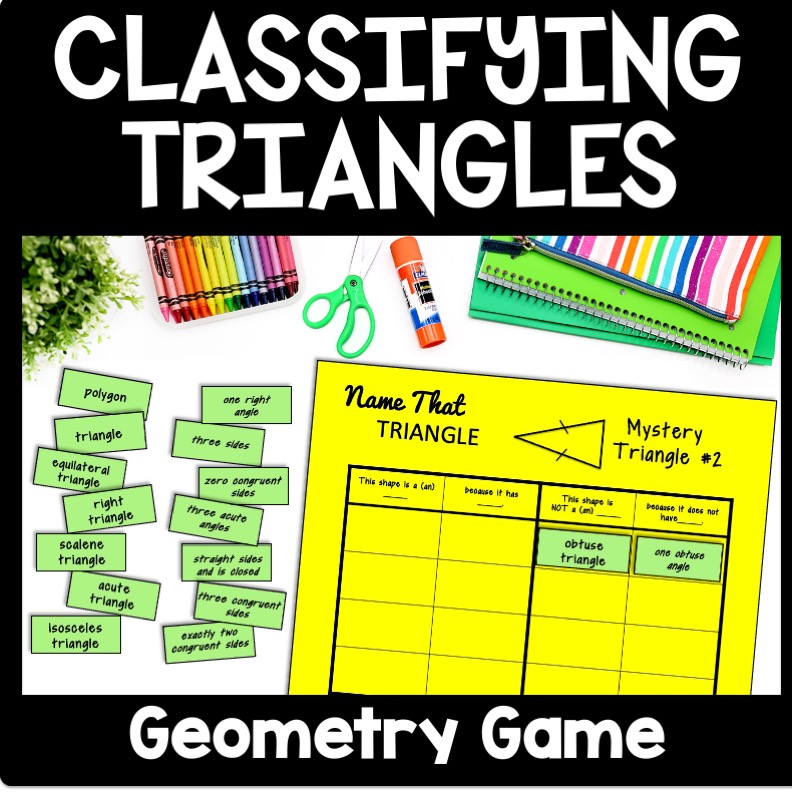
Want to see these classifying triangles strategies in action? Check out these videos:
Final Thoughts
Classifying triangles doesn’t have to feel overwhelming, for you or your students.
Try one or two of these tricks and see what sticks.
Because when students get it?
It’s one of those instant “light bulb” moments we all love.
Wishing you the most equilateral of days!
Math love,
Sally 💛
P.S. Don’t forget to grab your FREE CLASSIFYING TRIANGLES LESSON here!
FAQs
Why do students struggle with classifying triangles?
It combines spatial reasoning with new vocabulary, which can be overwhelming without the right supports.
What’s the best way to help students identify angle types?
Hands-on tools like the notecard trick and rotating paper can make a big difference.
Do students need to use all of these classifying triangles strategies?
No. Offer them as options. Students will naturally gravitate toward what works best for them. And some kids won’t need any of them (these are your future architects).
How can I help students remember triangle names?
Use memory tricks like “S-I-E → 0-2-3” and encourage students to write it in their workspace.
Why do students get confused by triangle names?
They often think there’s only one classification, instead of understanding that triangles can be named by both sides and angles.