
Flashcards get a bad rap sometimes.
People hear “multiplication flashcard activities” and think:
👉 Boring
👉 Repetitive
👉 Outdated
But in reality?
Times tables flashcards are one of the most versatile, low-prep, high-impact tools you can use in your math classroom.
When used intentionally, flashcards help students build fact fluency, strengthen mental math skills, and gain confidence with basic operations. It’s all about finding the right way to use them!
They build fact fluency.
They create quick practice opportunities.
They turn “dead time” into meaningful learning.
Let’s talk about how to make multiplication flashcard activities happen seamlessly and with zero prep.
Table of Contents
Why Flashcards Still Matter
At their core, flashcards help students:
- Build fact fluency
- Strengthen mental math recall speed
- Gain confidence with basic skills
And here’s the key:
👉 The more automatic the basics become, the more brainpower students have for higher-level thinking.
Incorporating multiplication flashcard activities is not the whole solution, but they are a powerful piece of it.
Teach Students to Use Flashcards Effectively
Don’t just hand students flashcards and expect mental math magic. We have to teach them how to use flashcards well.
👉 The Two-Pile Strategy
As students work through a stack of flashcards for math:
- Create one pile for:
✔️ “I got it right” - Create another pile for:
❗ “I need more practice”
Once they finish the stack, they revisit the “I need practice” stack and continue to add cards to the “I got it right” pile.
👉 Focus on Growth, Not Speed
Yes, fluency matters.
But accuracy comes first.
Always encourage students to:
- Think before answering
- Take the time to skip count on fingers if needed
- Learn from mistakes
- Celebrate mental math improvement
4 Easy Easy Multiplication Flashcard Activities Daily Mental Math
You don’t need a big, complicated system.
Sometimes the simplest uses are the most effective.
✔️ 1. Keep A Set in Each Student Desk
Early finishers?
Done with an assignment but not ready for the next task?
👉 Grab your times tables flashcards.
No extra directions or systems required. Students always know what to do if they’re done early.
✔️ 2. Use Them During “Waiting Time”
Teaching is full of those in-between moments with your students:
- Waiting in line
- Waiting for the restroom
- Waiting for a specials teacher to pick up your class
Instead of wasted time…
👉 Flashcards for times tables practice!
Quick, meaningful mental math practice in under a minute.
✔️ 3. Use flashcards as an easy Math Center
Flashcards make an excellent low-maintenance math center.
Here’s how:
- Pair students up
- One student quizzes the other (using the two-pile method from above)
- Once the deck is complete, revisit the “need more practice” pile
- Then they switch roles
Simple. Effective. No directions needed after that very first training.
✔️ 4. Play “Around the World”
Need a game to revive a tired class?
👉 This is one is a real BARN BURNER!
Important note- this game can get COMETITIVE. Only play it if you have built strong systems and have solid classroom management. Take a second to practice what it looks like to lose a round graciously. And to win a round without being mean.
How to Play “Around the World”
- Two students stand next to each other at one student’s desk
- The teacher shows a times table flashcard
- The first student to say the correct answer wins the round.
- The winner moves to the next seat and challenges the next student
- The student who answers incorrectly sits down in the open seat.
Goal:
👉 Make it all the way “around the world” and return to your original seat.
Important Rules for “Around the World”
- If a student answers incorrectly:
👉 Teacher signals “STOP” to that student
👉 This means the other student gets a chance - If students answer at the same time:
👉 Do a quick “Do Over” with a new flashcard
Why Students Love This Game:
- It’s fast-paced
- It’s competitive (in a fun way)
- It builds excitement around mental math
- Students are building times tables fluency just by observing, even if it’s not their turn!
Final Thoughts
I simply cannot imagine my classroom without multiplication flashcard activities. I hope these tricks and tips help you see the value in them. And before you go off and buy 30 sets of times tables flashcards for your classroom, I have a printable set in my TPT store! For less than $4!!
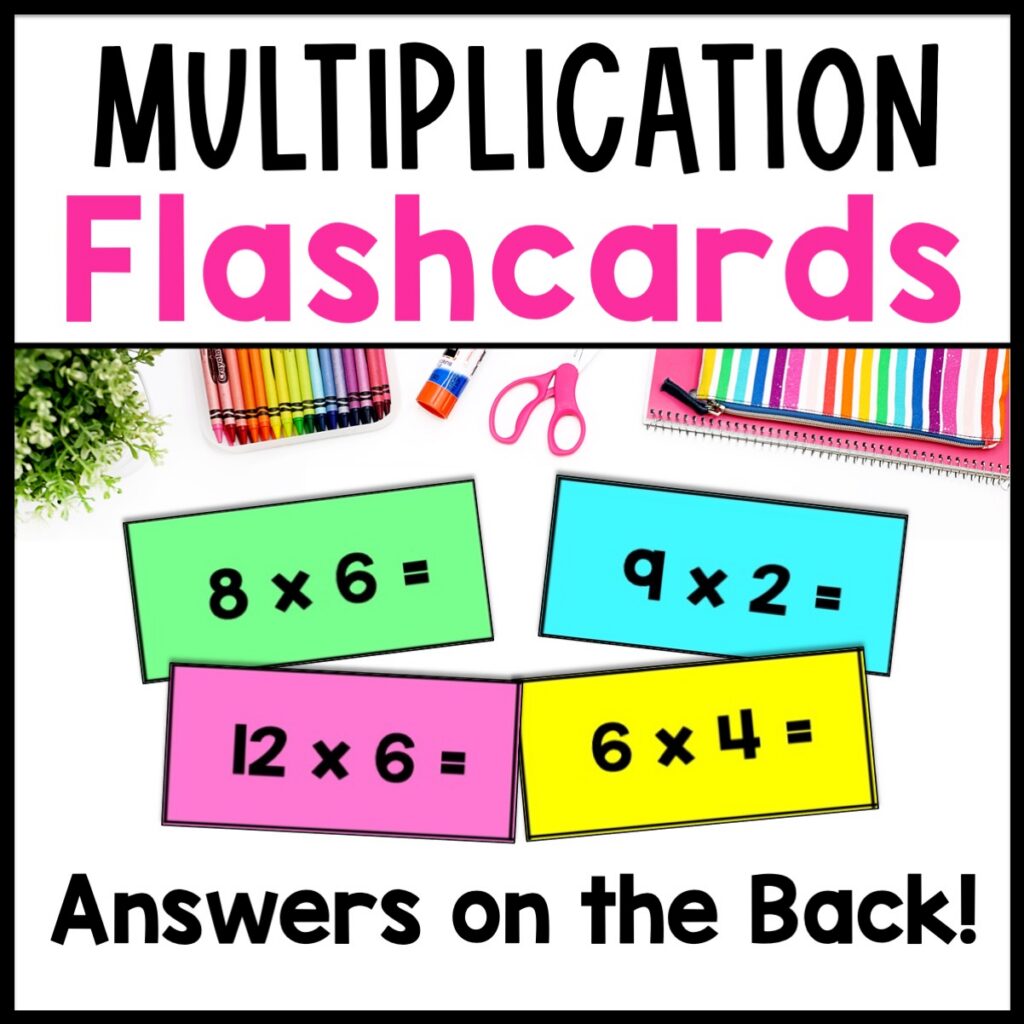
This set includes 4 different decks of multiplication flashcards, printable, and with answers on the back. Grab them and LAMINATE THEM!
Did I mention they’re less than $4?
Math love,
Sally 💛
FAQs
How often should I incorporate multiplication flashcard activities?
Daily! Even just a few minutes per day can significantly improve mental math fluency.
Are flashcards only for math times tables?
Absolutely not! Flashcards can be used for any mental math topic!
- The other 3 operations
- Math Vocabulary
- Simplifying Fractions
- Exponents or Square Roots
- The list goes on and on!
Can’t get enough of these speed mental math drills? Want to see my fluency bundles? I have 72 fact fluency sheets for all mental math skills for each grade level!
What if students get bored with flashcards?
Be sure you are mixing it up! Don’t always play Around the World. Use it as a math center too.
Students may be bored because they have memorized their times tables. Time to move on to flashcards for a new skill. Division facts? Simplifying fractions? The sky is the limit!
What’s more important- speed or accuracy?
Always, always accuracy. Speed will come with practice.
How do I manage flashcards in the classroom?
Keep a laminated set in every desk. Here’s mine if you need a printable set!
Then always have a set on your person for a lesson that runs short (Around the World) or a quick game in the hallway!
Which grade levels are best for these multiplication flashcard activities?
I have taught every grade level 4th – 9th and everybody (I mean EVERYBODY) benefits from times tables flashcards. For some higher-skilled students, you may need to make a new deck with harder problems.
How do I make sure students are focusing on the most challenging facts?
That’s where the “two pile” method comes into play! Students should be sorting the flashcards every time they review. They are creating a pile of their own “high-needs” facts and revistiing them again and again.
Do multiplication flashcard activities really make a difference?
1000% yes. When used consistently and intentionally, flashcards build the foundation students need for higher-level math success. When we reach times tables fluency, we are freeing up the brain to take on harder math tasks.
3 Responses