Are you dreading teaching volume to your 5th graders? You’re not alone. The good news is that volume can be painless and even, dare I say it, fun.
After years of teaching this unit (and learning a few lessons the hard way), I’ve collected six simple hacks that make volume click for students. Chances are you haven’t tried at least one of them yet.
Table of Contents
Definition of Volume in 5th Grade Math
First be sure you have a solid, working definition of volume in fifth grade math.
Volume is the amount of three-dimensional space an object takes up or occupies. It is measured in 3D cubes, which have three dimensions- length, width, and height.
In 5th grade, students are just required to find the volume of a rectangular prism and to solve real-world problems involving rectangular prisms.
5th Grade Volume Hack 1: Units matter
Say it with me: cubic inches, cubic meters, cubic feet.
Have students say the units out loud and write them correctly every single time. Volume is made of cubes, which are three-dimensional, just like area is made of squares, which are two-dimensional.
That connection only starts to make sense to students when we name the units correctly, consistently. If we shortcut to “inches” or “units,” we lose the very idea we’re trying to teach.
5th Grade Volume Hack 2: Bust out the colored pencils
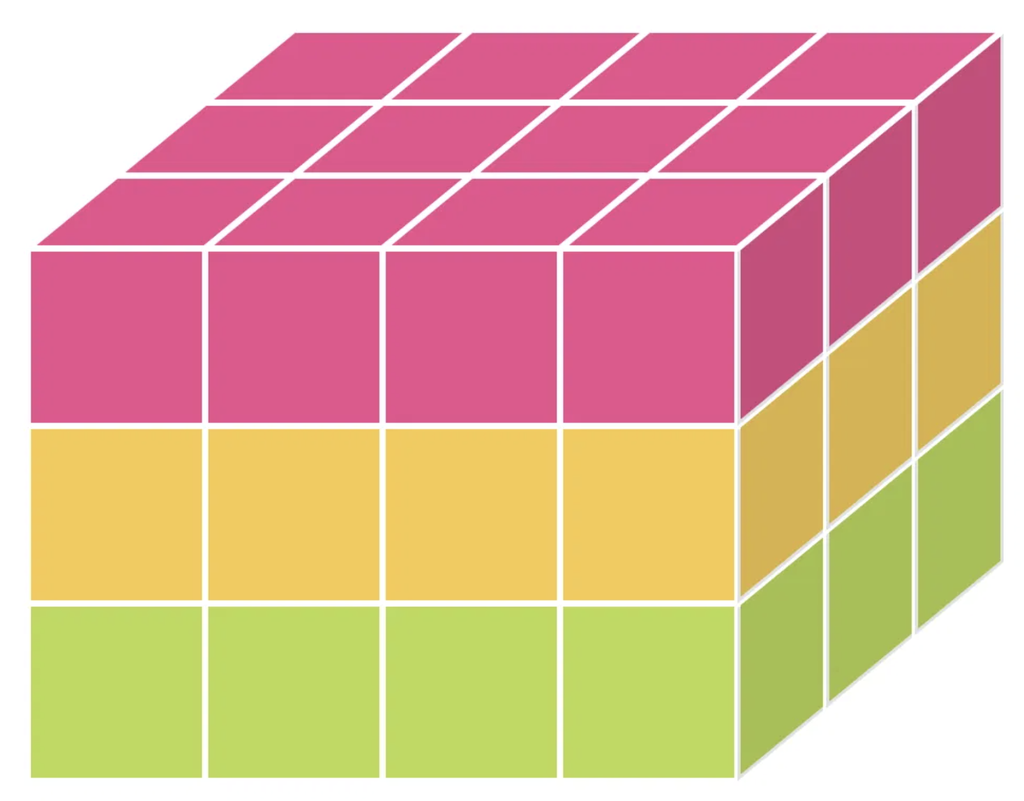
Give students a picture of a rectangular prism built from cubes and have them:
- Shade the base (usually the face visible on top).
- Color each “layer” of cubes a different color.
Seeing the layers stack up helps students understand why the formula works. The base is one layer, and the height tells you how many layers there are. That’s Volume = B × h, and it’s also length × width × height, because length × width gives you the area of the base.
- Here we can see that the base layer (pink) is made up of 12 cubes
- This rectangular prism has 3 layers (pink, yellow, green) and each of them is 12 cubes
- 12 + 12 + 12 = 36
We can also connect this to the standard algorithm and say:
- The length and width of the “roof” is 3 units x 4 units and the height is 3 units.
- l x w x h = 3 x 4 x 3 = 36 cubic units
5th Grade Volume Hack 3: Multiply the two biggest dimensions first
One of the tricky things with 5th grade volume is when kids master the concept, only to turn around and make a multiplication error.
This one works for rectangular prisms only, but it’s a game changer for messy calculations.
When students multiply the two largest dimensions first, the smallest dimension is left for last. That last number is often a single digit, which makes the final step much easier.
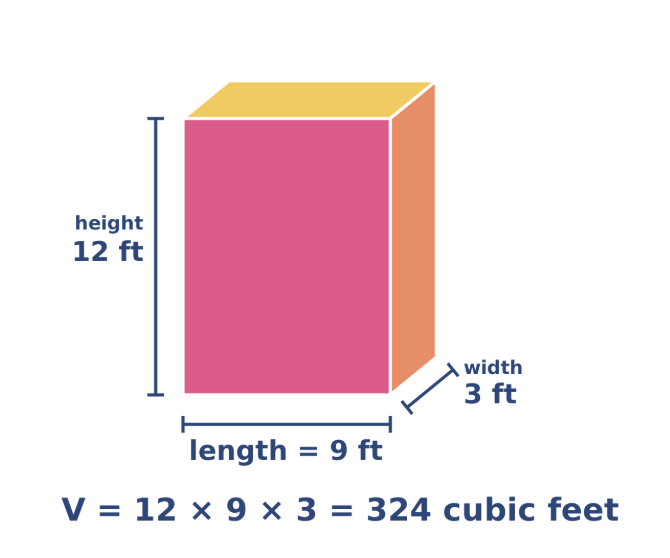
For example, a prism that’s 12 ft × 3 ft × 9 ft:
- 12 × 9 = 108
- 108 × 3 = 324 cubic feet
Multiplication is commutative, so the answer is the same in any order. This just keeps the arithmetic cleaner and the errors fewer.
5th Grade Volume Hack 4: Don’t use tiny base ten blocks!
Warning: do not, under any circumstances, use tiny base-ten unit cubes as a manipulative for teaching volume. Trust me on this one. Don’t ask how I know.
Yes, I know you have an abundance of base ten blocks, but most kids don’t have the fine-motor dexterity to build a prism with those little cubes, and the lesson quickly turns into a frustrating cleanup.
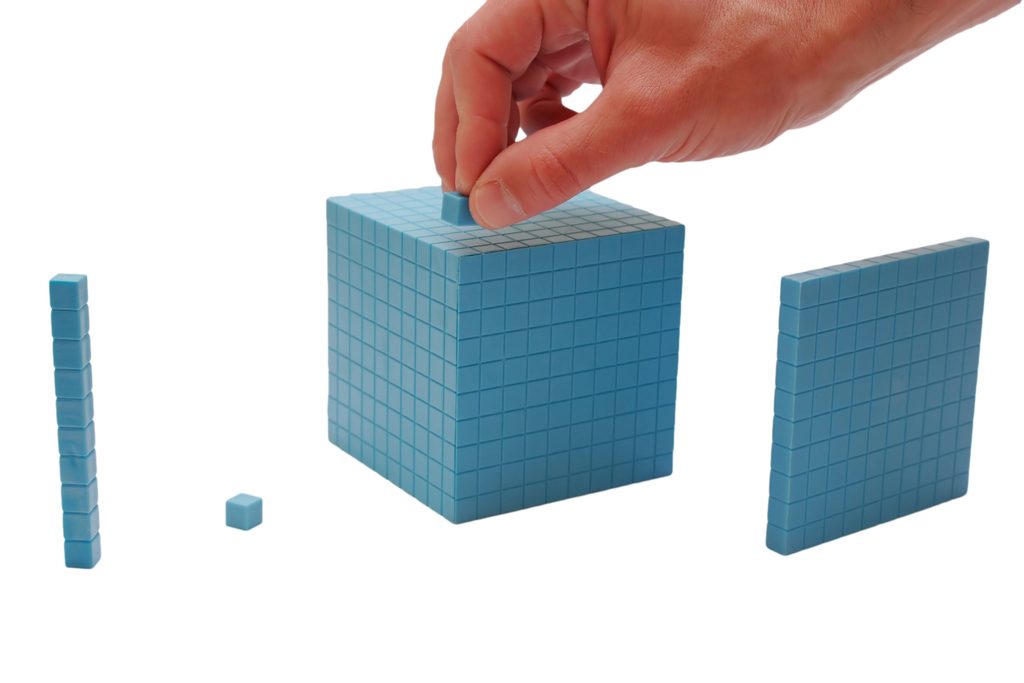
As my good friend Taylor says: Don’t say I didn’t, say I didn’t, WARN YOU.

If you want hands-on manipulatives, try wooden blocks that are at least 2 cm (about 0.8 inches) on each side. They’re easy to grab, stack and count. Here’s my favorite set on amazon. Having enough for the whole class can be pricey, so it’s ok to make this a center activity so that kids get hands on practice one group at a time.
Looking for an easy way to make volume hands on? Here’s an activity I love to use to introduce volume with physical cubes!
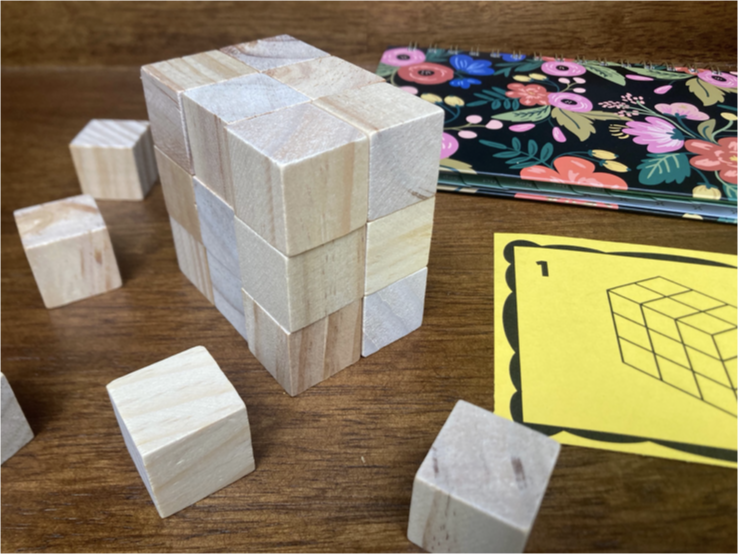
Step 1: Students are given a task card with a photo of a rectangular prism and must build it out of cubes
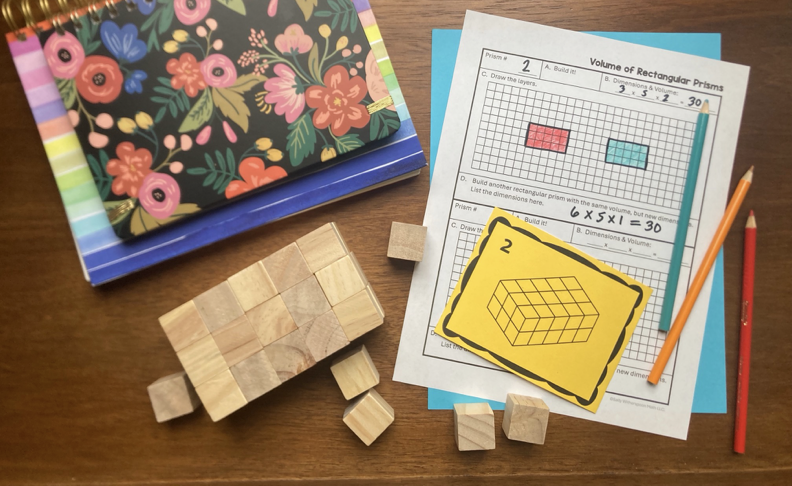
Step 2: Students sketch the layers of the cube on grid paper and then calculate the volume
Grab this Hands on Volume Activity here!
5th Grade Volume Hack 5: Be on the lookout for double counting
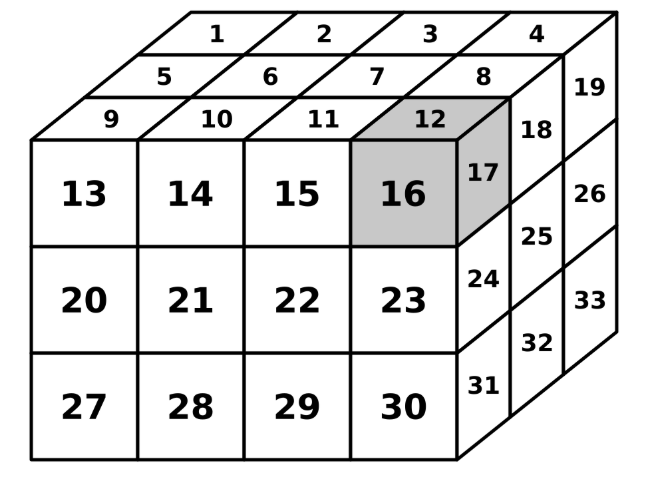
Sometimes students over-rely on counting cubes and will mistakenly double count the same cube twice (or even three times).
This student is confusing volume with surface area. Be sure to utilize the strategy of shading layers (hack 2) and building rectangular prisms with manipulatives (hack 4).
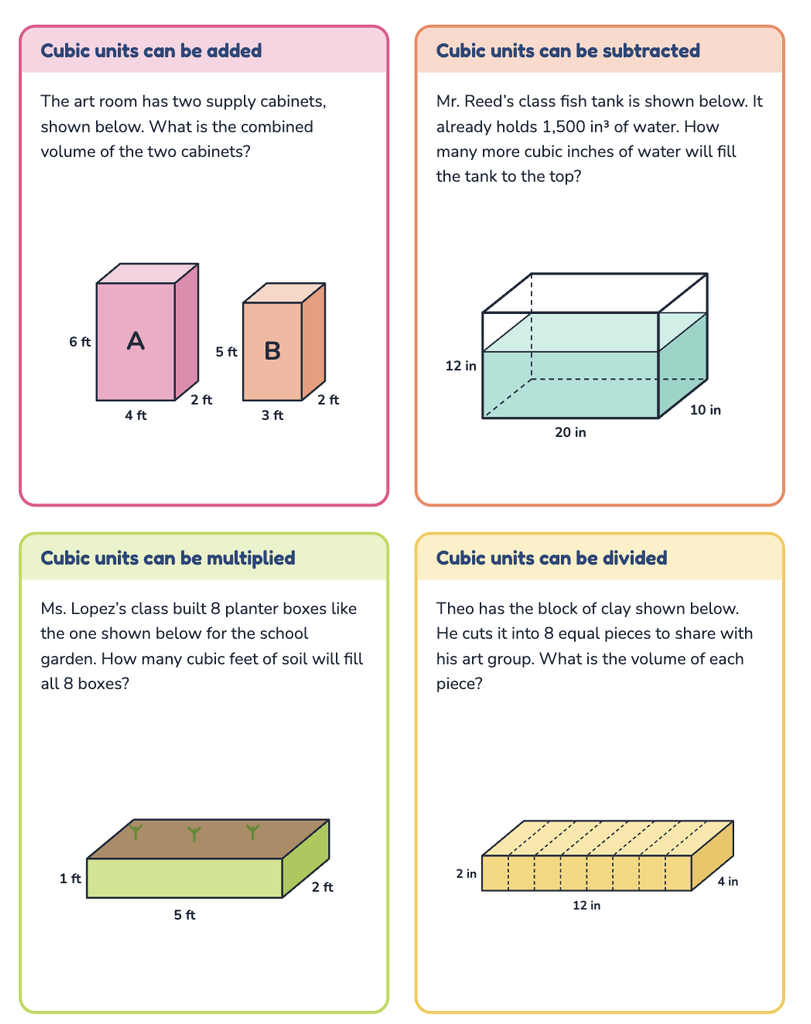
5th Grade Volume Hack 6: Cubic units can be added, subtracted, multiplied, & divided
Once students have mastered finding the volume of one rectangular prism through a variety of strategies (layering, counting, multiplying).
They will see that they can solve a variety of problems involving cubic units. Just like any other unit (pencils, lemons, books) can be added, subtracted, multiplied, and divided, so can cubic units.
Here’s a full lesson packet where students must apply their knowledge to a variety of situations involving volume: Solving Problems Involving Cubic Units.
Need more support for Teaching 5th Grade Volume?
Here are some of my favorite done-for-you resources, ready to print and use tomorrow!
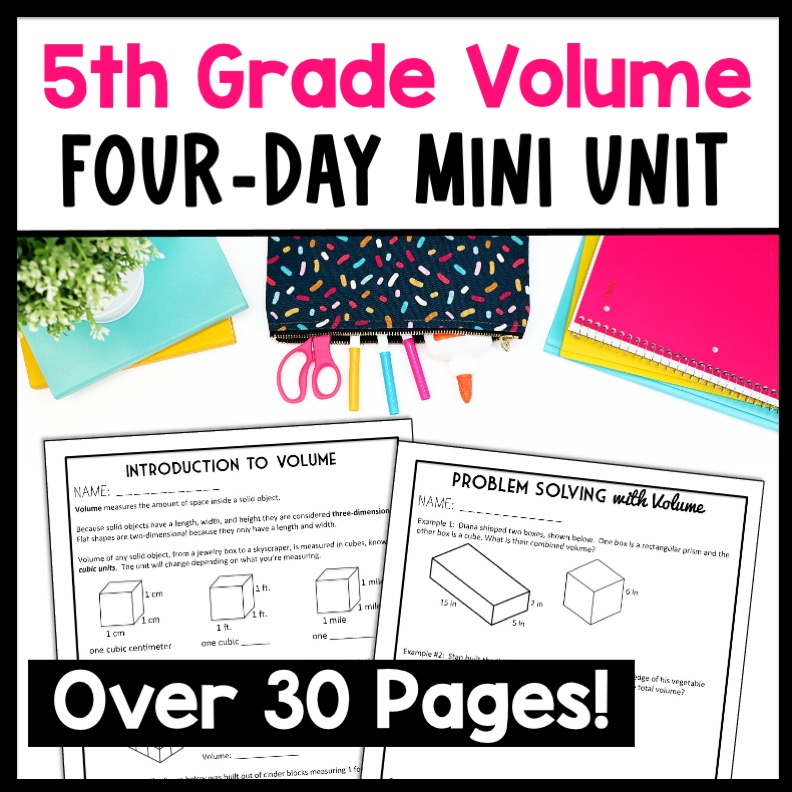
My 4-Day Mini Volume Unit includes four 8-page lesson packets. Each one has teacher-led examples, partner practice, scaffolded independent practice, a challenge for early finishers, and an exit ticket.
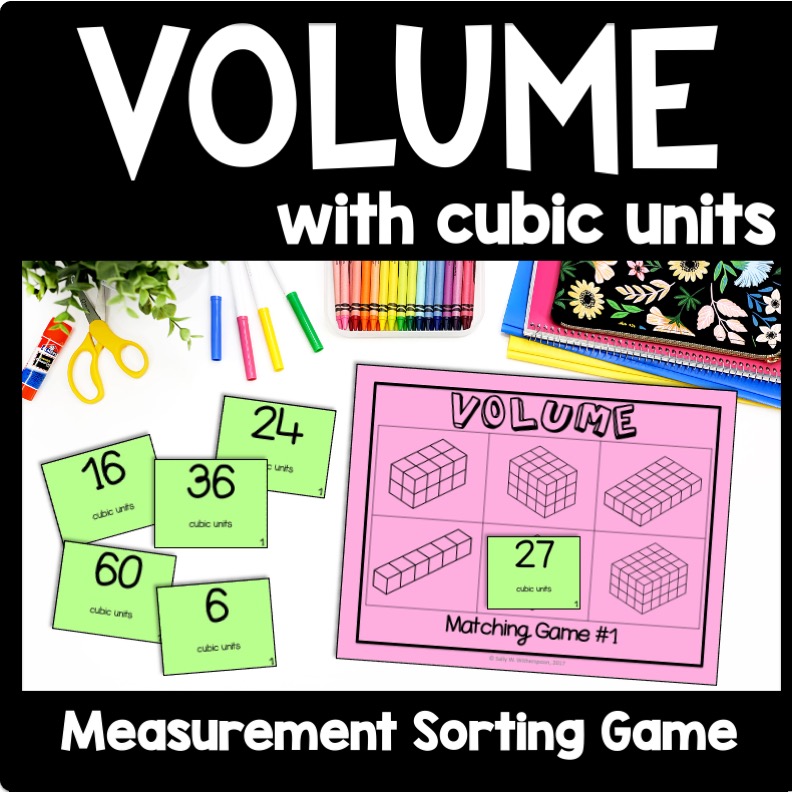
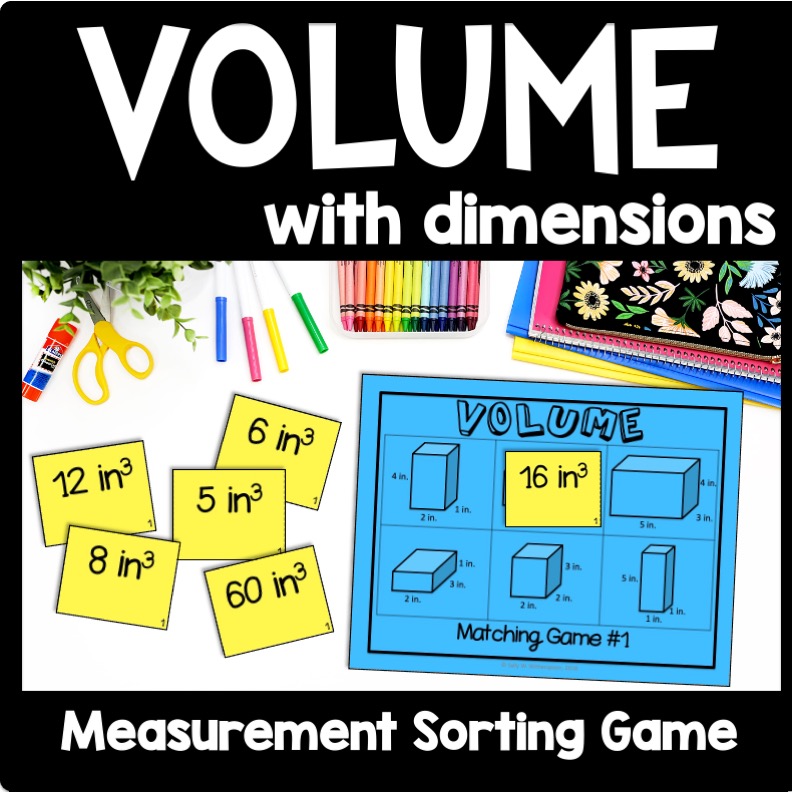
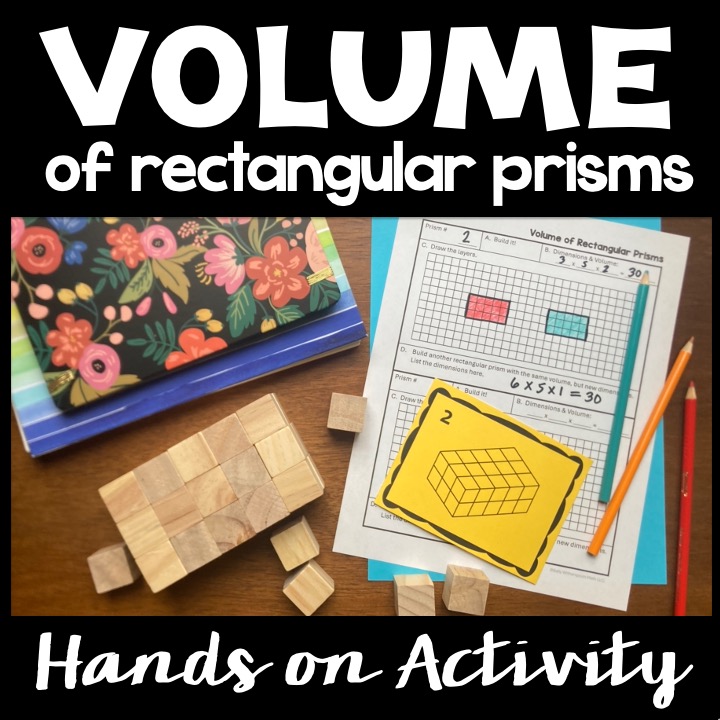
Looking for ways to make your volume unit more engaging or hands-on?
- Volume with Cubic Units Sorting Game
- Volume with Dimensions Sorting Game
- Volume with Manipulatives Hands on Activity
Final Thoughts on Volume in 5th Grade
Teaching volume in 5th grade doesn’t have to be a struggle. When students say their units correctly, see the layers stack up, multiply in a smart order, and build with cubes they can actually handle, the formula stops being something to memorize. It becomes something they understand.
You don’t need to try all six hacks at once. Pick one for tomorrow’s lesson, watch how your students respond, and add another the next day.
Most of all, give your students time. Volume is a big jump from flat shapes to 3D thinking, and every kid gets there at their own pace.
Your turn
What measurement skill should we tackle next? Let me know in the comments!
Wishing you the most 3-dimensional of days and, as always, math love,
Sally 💛
FAQs About Teaching Volume in 5th Grade
What is volume in 5th grade math?
Volume is the amount of space inside a 3D figure. In 5th grade, students find the volume of rectangular prisms by counting unit cubes and then by using a formula.
Why is volume measured in cubic units?
Volume is made of cubes, and cubes have three dimensions: length, width and height. Area is made of squares, so it’s measured in square units. Saying “cubic inches” or “cubic feet” every time helps students keep the two straight.
What is the formula for the volume of a rectangular prism?
There are two, and they mean the same thing: V = l × w × h and V = B × h. B is the area of the base, which is length × width. The height tells you how many layers of that base are stacked up.
What’s the easiest way to multiply three dimensions?
Multiply the two biggest numbers first. The smallest number is left for last, and it’s often a single digit, so the final step is easier.
What manipulatives are best for teaching volume?
Use wooden or plastic cubes that are at least 2 cm (about 0.8 inch) on each side. Tiny base-ten unit cubes are too small for most kids to build a prism with.
How do you find the volume of a figure made of two prisms?
Split the figure into two rectangular prisms that don’t overlap. Find the volume of each one, then add them together. This is called additive volume.
What standards cover volume in 5th grade?
Volume is taught in Common Core standards 5.MD.C.3, 5.MD.C.4 and 5.MD.C.5. These cover understanding volume, counting unit cubes and using the formulas to solve real-world problems.